
Budget 2018-19 & the Finance Bill 2018 have been tabled in Parliament. The Income Tax Slab rates have been kept unchanged by the Finance Minister for the Financial Year 2018-19 (Assessment Year 2019-2020).
Tax planning is an important part of a financial plan. Whether you are a salaried individual, a professional or a businessman, you can save taxes to certain extent through proper tax planning.
The Indian Income Tax act allows for certain Tax Deductions / Tax Exemptions which can be claimed to save tax. You can subtract tax deductions from your Gross Income and your taxable income gets reduced to that extent.
Latest Update (01-Feb-2019) : Budget 2019 Key Highlights & Revised Income Tax Exemption FY 2019-20
In this post, let us go through the Income Tax Deductions List FY 2018-19, best ways to save taxes and best tax saving options for FY 218-19 / AY 2019-20. I hope you find this list useful and helps in planning your taxes well in advance.
Income Tax Deductions List FY 2018-19 / AY 2019-20 (Chapter VI-A deductions list)
Section 80c
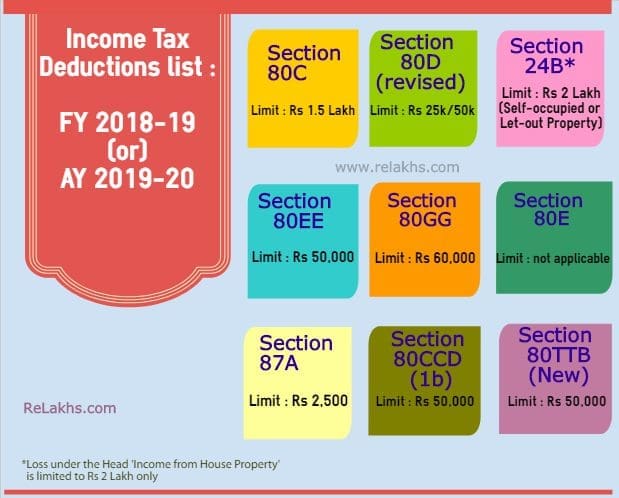
The maximum tax exemption limit under Section 80C has been retained as Rs 1.5 Lakh only. The various investment avenues or expenses that can be claimed as tax deductions under section 80c are as below;
- PPF (Public Provident Fund)
- EPF (Employees’ Provident Fund)
- Five year Bank or Post office Tax saving Deposits
- NSC (National Savings Certificates)
- ELSS Mutual Funds (Equity Linked Saving Schemes)
- Kid’s Tuition Fees
- SCSS (Post office Senior Citizen Savings Scheme)
- Principal repayment of Home Loan
- NPS (National Pension System)
- Life Insurance Premium (Read : ‘Best Term insurance plans‘)
- Sukanya Samriddhi Account Deposit Scheme
(Read : ‘Tax Saving Investment Options u/s 80c | In whose name can they be Invested?’)
Section 80CCC
Contribution to annuity plan of LIC (Life Insurance Corporation of India) or any other Life Insurance Company for receiving pension from the fund is considered for tax benefit. The maximum allowable Tax deduction under this section is Rs 1.5 Lakh.
Section 80CCD
Employee can contribute to Government notified Pension Schemes (like National Pension Scheme – NPS). The contributions can be upto 10% of the salary (salaried individuals) and Rs 50,000 additional tax benefit u/s 80CCD (1b) was proposed in Budget 2015.
As per the previous Budget 2017-18, the self-employed (individual other than the salaried class) can contribute up to 20% of their gross income and the same can be deducted from the taxable income under Section 80CCD (1) of the Income Tax Act, 1961, as against current 10%.
To claim this deduction, the employee has to contribute to Govt recognized Pension schemes like NPS. The 10% of salary limit is applicable for salaried individuals only and Gross income is applicable for non-salaried. The definition of Salary is only ‘Dearness Allowance.’ If your employer also contributes to Pension Scheme, the whole contribution amount (10% of salary) can be claimed as tax deduction under Section 80CCD (2).
Kindly note that the Total Deduction under section 80C, 80CCC and 80CCD(1) together cannot exceed Rs 1,50,000 for the financial year 2018-19. The additional tax deduction of Rs 50,000 u/s 80CCD (1b) is over and above this Rs 1.5 Lakh limit.
(Read : ‘NPS Scheme – Pros & Cons‘)
Contributions to ‘Atal Pension Yojana‘ are eligible for Tax Deduction under section 80CCD.
Section 80D
In the union budget 2018, the government of India has proposed the below changes with respect to deductions available on Health Insurance and/or towards Medical treatment ;
- Health Insurance & Senior Citizens : In Budget 2018, it has been proposed to raise the maximum tax deduction limit for senior citizens under Section 80D of the Indian Income Tax Act 1961. The current limit of tax deduction allowed for FY 2017-18 for senior citizens is Rs. 30,000 which will be increased to Rs 50,000, from FY 2018-19 (AY 2019-20) onwards.
- Under Section 80D an assessee, being an individual or a Hindu undivided family, can claim a deduction in respect of payments towards annual premium on health insurance policy, preventive health check-up or medical expenditure in respect of senior citizen (above 60 years of age).
- As of FY 2017-18, only Very Senior Citizens (who are above 80 years of age), can claim a deduction of up to Rs 30,000 incurred towards medical expenditure, in case they don’t have health insurance. The Budget 2018 has increased this to Rs 50,000 and also allowed the same flexibility to senior citizens. Even individuals who pay premiums for their dependent senior citizens parents can claim the additional deduction on health insurance premium (or) medical expenditure.
- Single premium Health Insurance policy / Multi-year Mediclaim policy :
- In case of single premium health insurance policies having cover of more than one year, it is proposed that the deduction shall be allowed on proportionate basis for the number of years for which health insurance cover is provided, subject to the specified monetary limit.
The below revised limits are applicable for Financial Year 2018-2019 (or) Assessment Year (2019-2020) u/s 80D.
Preventive health checkup (Medical checkups) expenses to the extent of Rs 5,000/- per family can be claimed as tax deductions. Remember, this is not over and above the individual limits as explained above. (Family includes: Self, spouse, parents and dependent children).
Section 80DD
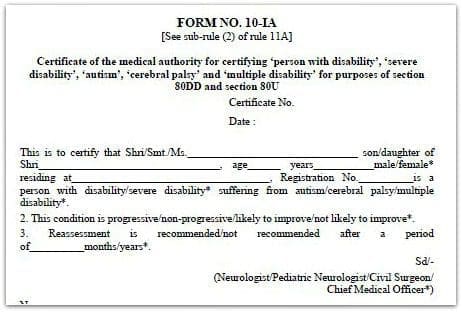
You can claim up to Rs 75,000 for spending on medical treatments of your dependents (spouse, parents, kids or siblings) who have 40% disability. The tax deduction limit of upto Rs 1.25 lakh in case of severe disability can be availed.
To claim this deduction, you have to submit Form no 10-IA.
Section 80DDB
An individual (less than 60 years of age) can claim upto Rs 40,000 for the treatment of specified critical ailments. This can also be claimed on behalf of the dependents. The tax deduction limit under this section for Senior Citizens and very Senior Citizens (above 80 years) has been revised to Rs 1,00,000.
To claim Tax deductions under Section 80DDB, it is mandatory for an individual to obtain ‘Doctor Certificate’ or ‘Prescription’ from a specialist working in a Govt or Private hospital.
For the purposes of section 80DDB, the following shall be the eligible diseases or ailments:
- Neurological Diseases where the disability level has been certified to be of 40% and above;
(a) Dementia
(b) Dystonia Musculorum Deformans
(c) Motor Neuron Disease
(d) Ataxia
(e) Chorea
(f) Hemiballismus
(g) Aphasia
(h) Parkinson’s Disease
- Malignant Cancers
- Full Blown Acquired Immuno-Deficiency Syndrome (AIDS) ;
- Chronic Renal failure
- Hematological disorders
- Hemophilia
- Thalassaemia
Section 80CCG
Tax Benefits of Rajiv Gandhi Equity Savings Scheme (
Section 24 (B) (Loss under the head Income from House Property)
- From FY 2017-18, the Tax benefit on loan repayment of second house is restricted to Rs 2 lakh per annum only (even if you have multiple houses the limit is still going to be Rs 2 Lakh only and the ceiling limit is not per house property).
- The unclaimed loss if any will be carried forward to be set off against house property income of subsequent 8 years. In most of the cases, this can be treated as ‘dead loss‘.
- I believe that this is a major blow to the investors who have bought multiple houses on home loan(s) with an intention to save taxes alone.
- Until FY 2016-17, interest paid on your housing loan is eligible for the following tax benefits ;
- Municipal taxes paid, 30% of the net annual income (standard deduction) and interest paid on the loan taken for that house are allowed as deductions.
- After these deductions, your rental income can be NIL or NEGATIVE and is called ‘loss from house property’ in the latter case.
- Such loss is currently allowed to be set off against other heads of income like Income from Salary or Business etc. which helps you to lower you tax liability substantially.

Section 80E
If you take any loan for higher studies (after completing Senior Secondary Exam), tax deduction can be claimed under Section 80E for interest that you pay towards your Education Loan. This loan should have been taken for higher education for you, your spouse or your children or for a student for whom you are a legal guardian. Principal Repayment on educational loan cannot be claimed as tax deduction.
There is no limit on the amount of interest you can claim as deduction under section 80E. The deduction is available for a maximum of 8 years or till the interest is paid, whichever is earlier.
Section 80EE
This was a new proposal which had been made in Budget 2016-17. The same will be continued in FY 2018-19 / AY 2019-20 too. First time Home Buyers can claim an additional Tax deduction of up to Rs 50,000 on home loan interest payments u/s 80EE. The below criteria has to be met for claiming tax deduction under section 80EE.
- The home loan should have been sanctioned during FY 2016-17.
- Loan amount should be less than Rs 35 Lakh.
- The value of the house should not be more than Rs 50 Lakh &
- The home buyer should not have any other existing residential house in his name.
- Such eligible home buyers can claim exemption of Rs. 50,000/- for interest on home loan under section 80EE from assessment year beginning from 1 st April 2017 and subsequent years.
Section 80G
Contributions made to certain relief funds and charitable institutions can be claimed as a deduction under Section 80G of the Income Tax Act. This deduction can only be claimed when the contribution has been made via cheque or draft or in cash. In-kind contributions such as food material, clothes, medicines etc do not qualify for deduction under section 80G.
The donations made to any Political party can be claimed under section 80GGC.
W.e.f FY 2017-18, the limit of deduction under section 80G / 80GGC for donations made in cash is reduced from current Rs 10,000 to Rs 2,000 only.
If you want to donate some fund to a political party of your choice, you can do so in cash of up to Rs 2,000. Beyond that you can not donate the amount in cash mode. It can be done through Electoral Bonds.
Section 80GG
The Tax Deduction amount under 80GG is Rs 60,000 per annum. Section 80GG is applicable for all those individuals who do not own a residential house & do not receive HRA (House Rent Allowance).
The extent of tax deduction will be limited to the least amount of the following;
- Rent paid minus 10 percent the adjusted total income.
- Rs 5,000 per month.
- 25 % of the total income.
(If you are claiming HRA (House Rent Allowance) of more than Rs 50,000 per month (or) paying rent which is more than Rs 50,000 then the tenant has to deduct TDS @ 5%. It has been proposed that the tax could be deducted at the time of credit of rent for the last month of the tax year or last month of tenancy, as applicable.)
Rebate under Section 87A
Tax rebate of Rs 2,500 for individuals with income of up to Rs 3.5 Lakh has been proposed in Budget 2017-18 and the same will be continued for FY 2018-19 / AY 2019-20 as well.
- Only Individual Assesses earning net income up to Rs 3.5 lakhs are eligible to enjoy tax rebate u/s 87A.
- For Example : Suppose your yearly pay comes to Rs 4,50,000 and you claim Rs 1,50,000 u/s 80C. The total net income in your case comes to Rs 3,00,000 which makes you eligible to claim tax rebate of Rs 2,500.
- The amount of tax rebate u/s 87A is restricted to maximum of Rs 2,500. In case the computed tax payable is less than Rs 2,500, say Rs 2,000 the tax rebate shall be limited to that lower amount i.e. Rs 2,000 only.
- The Tax Assesse is first required to add all incomes i.e. salary, house income, capital gains, business or profession income and income from other sources and then deduct the eligible tax deduction amounts u/s 80C to 80U and under section 24(b) (Home Loan Interest) to come up with the net taxable income.
- If the above net taxable income happens to be less than Rs 3.5 lakhs then the tax rebate of Rs 2,500 comes in to the picture and should be deducted from the calculated total income tax payable.
Section 80 TTA & new Section 80TTB
For Senior Citizens, the Interest income earned on Fixed Deposits & Recurring Deposits (Banks / Post office schemes) will be exempt till Rs 50,000 (FY 2017-18 limit is up to Rs 10,000). This deduction can be claimed under new Section 80TTB. However, no deductions under existing 80TTA can be claimed if 80TTB tax benefit has been claimed (the limit for FY 2017-18 & FY 2018-19 u/s 80TTA is Rs 10,000).
Section 80TTA of Income Tax Act offers deductions on interest income earned from savings bank deposit of up to Rs 10,000. From FY 2018-19, this benefit will not be available for late Income Tax filers.
Interest income from deposits held with companies will not benefit under this section. This means, senior citizens will not get this benefit for interest income from corporate fixed deposits us/ 80TTB.
Section 80U
This is similar to Section 80DD. Tax deduction is allowed for the tax assessee who is physically and mentally challenged.
Standard Deduction of Rs 40,000 in-lieu of Medical Allowance – Budget 2018
For FY 2017–18, the medical allowance of up to Rs 15,000 is exempted income from your Gross salary. To claim this, you need to submit medical bills to your employer and get the allowance benefit. The medical reimbursement allowance is exempted under Section 10 of the Income Tax Act.
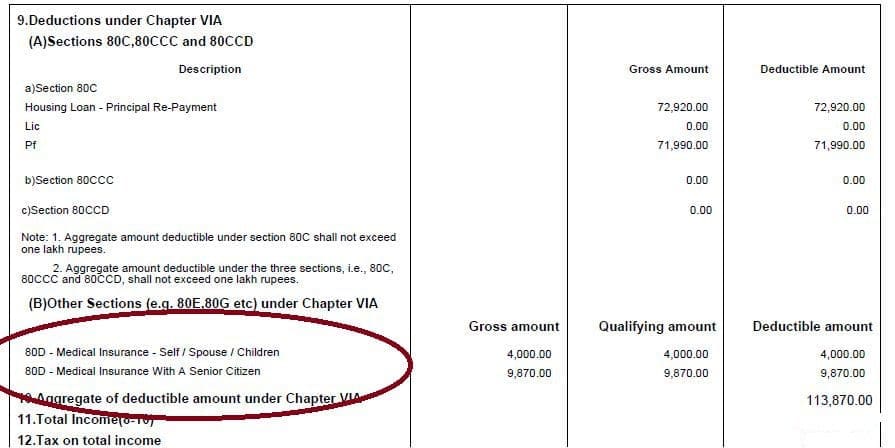
If you have submitted medical bills (to your employer) towards medical allowance and also paid premium towards your mediclaim (health insurance) then both of them will be listed in your Form-16 under different sections as shown below (click on the images to open them in new browser window).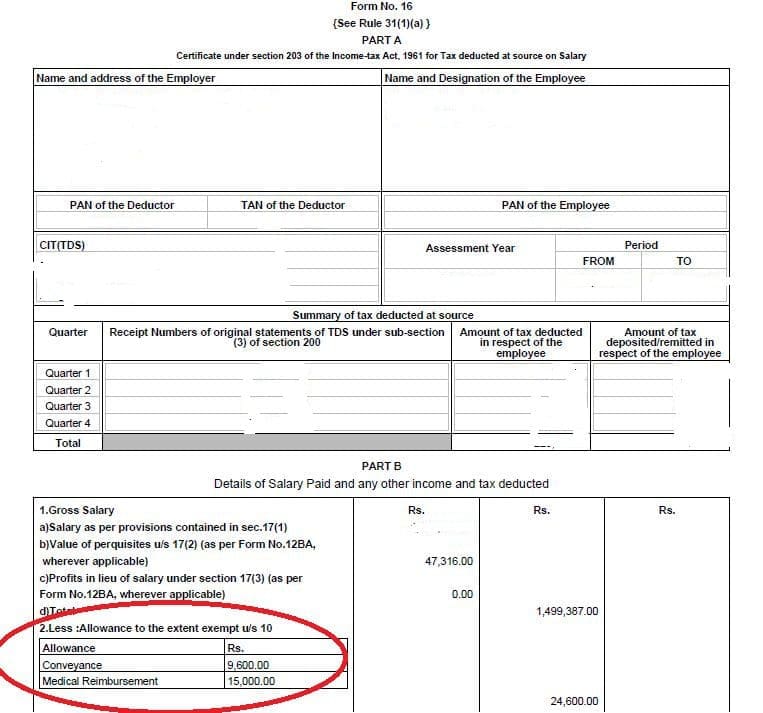
From FY 2018-19, a standard deduction of Rs 40,000 in lieu of travel, medical expense reimbursement and other allowances has been proposed for salaried employees and pensioners. To claim this standard deduction, there is no need to submit medical bills to your employer.
As per this new proposal, irrespective of amount of taxable salary the assessee will be entitled to get a deduction of Rs.40,000 or taxable salary, whichever is less. Thus suppose if a person has worked for few days (or) months and his salary was just Rs 40,000 for a previous year, then he will be entitled to deduction equal to salary being the same amount. If his salary is less, say Rs 30,000 the deduction shall be restricted to Rs 30,000. If salary exceeds amount of Rs 40,000, the deduction shall be restricted to Rs 40,000.
Conclusion
It is prudent to avoid last minute tax planning. Do not invest in low-yielding life insurance polices or in any other financial products just to save taxes. It is better you plan your taxes based on your financial goals at the beginning of the Financial Year itself. Plan your taxes from April 2018 itself, instead of waiting until late December 2018 (or) January 2019.
It is OK to pay some taxes when you can not save or cannot invest in right financial products. But, do not invest just to save TAXES. The cost of buying wrong financial products may outweigh the cost of taxes. Tax Planning is not a goal but a tool. Remember “Tax Planning alone is not Financial Planning.”
Also, kindly understand the tax treatment of the selected investment products across the different investment stages (i.e., investment, accrual & withdrawal) and then invest. (Read : ‘Tax treatment of various Financial Investments‘)
I believe that the above list is useful for your Tax Planning purposes. Kindly note that these Income Tax Exemptions are applicable for financial year 2018-2019 (or Assessment Year 2019-2020).
Continue reading :
- Income Tax Slab Rates for FY 2018-19 / AY 2019-18 | Budget 2018-19
- Income Tax Deductions List FY 2017-18
- Mutual Funds Capital Gains Taxation Rules FY 2018-19 (AY 2019-20) | Capital Gains Tax Rates Chart
- Health Insurance Tax Benefits (under Section 80D) for FY 2018-19 / AY 2019-20
- Tax Saving investment options u/s 80c : In whose name can they be invested?
- Income Tax Slab Rates for FY 2017-18 / AY 2018-19 (Budget 2017-18)
- Income Tax Declaration & List of Investment Proofs
- Best ELSS Tax-saving Mutual Fund Schemes
- Rs 40,000 Standard Deduction from FY 2018-19 | Does it really benefit the Salaried?
- FY 2018-19 Section 80TTB | Tax Exemption of Rs 50,000 on Interest Income to Senior Citizens
(Image courtesy of Stuart Miles at FreeDigitalPhotos.net) (Post first published on : 09-March-2018)
Join our channels



Suppose already submitted the ITR but in fact I am suppose to get refund then what is to be done to get refund as the Bank deducted amount on extra source of Income was shown more than actual.
Dear Trivikrama,
I am assuming that you are referring to AY 2019-20 ITR, if so, you can get the ITR revised.
Dear Viswanathan,
Kindly consult a CA who takes care of NRI taxation matters..
Respected Shri. Sreekanth Reddy Sir,
I worked in Singapore between 2006 – 2009, and had an SB account in a Bank POSB in Singapore. I left the job in 2009 and came back to India.
However i had not closed the account and this account has got about Singapore $ 17000. I forgot about this totally and in the ITR 2 in the declaration i missed mentioning this amount.
This amount S $ 17000 is after income tax paid to Singapore Government.
I had no intention of not disclosing this. As you know this amount in Savings bank earns interest of about 20 – 30 dollars per year.
Now what should i do since i forgot to mention about this while filing IT returns last two years. What is the recource now as i have always been a honest tax payer to the government.
Thanks and Regards,
Viswanathan
Dear Viswanathan,
Have you forgotten the amount? or Disclosing about it in your ITR? 🙂
Has your previous AY ITR been processed?
If yes, suggest you to disclose this amount from this AY 2019-20 (if not yet filed). If filed, you may revise it.
Related article :
What is Double Taxation Avoidance Agreement (DTAA)? | Is Income earned outside India Taxable?
One query,
If a property is registered in my wife’s (non working housewife) name and she is co-applicant for loan application with me and i’m fully repaying the home loan from my account. Can I claim IT deductions.
Dear Dhiraj,
As you are not a co-owner of the property, you can not claim tax benefit..
Related articles :
* Joint Home Loan : Eligibility rules & Income Tax Benefits
* 5 ways of transferring your Immovable (or) Real Estate Property
* Options for adding Spouse’s name as co-owner of the Property
Hi, I am about to complete the deal of purchase of my new first home before 31 March 2019. Then, can I claim stamp duty and registration charges for FY 2018-19 & AY 2019-20. Under which section please guide me.
Dear Dhiraj,
You can claim it u/s 80c..
For claiming stamp duty deduction u/s 80c, you must possess the house also i.e. Payment for under-construction is not allowed. In simple words both payment of expenses and possession of the house must be in the same fiscal year for claiming expenses.
Can you explain, who are eligible to get benefit Rs.4000 under 17(2) & what document required.
Dear SMRUTI,
You may kindly go through this link..
Hi,
My Father’s age is 68 and Pension is ₹3,90,000, 80C Deduction is 21600₹, Interests from Savings is 7500₹, Is IT is payable? Is there any other section in which i can claim something. Like Family Medicinal Exps, Father is having Retinetis Pigmentosa which is incurable disease though we haven’t obtained any governmental certificate for it but only private doctor’s prescribtion for this.
Dear Ahmad,
The basic exemption limit is Rs 3 lakh for Senior citizens for FY 2018-19.
Kindly go through the points given under ‘Section 80D – medical expenses for Senior citizens’ in the above article.
Related article :
Income Tax Deductions List FY 2019-20 | List of important Income Tax Exemptions for AY 2020-21
Sir,
for deciding income tax slab what is the as on date to determine age ?
Dear Mr Das,
While considering the higher exemption limit of tax liability for senior and very senior citizens, a person will be considered to have attained a particular age on March 31 if his or her birthdate is a day later on April 1, the CBDT today said.
You may kindly go through this article link..
Stamp duty has been paid by parents and son has taken loan for home. Can we get exemptions for Stamp duty paid while purchasing home
Can son take exemption of stamp duty as Parents are retired and dont have any income other than family pension.
Dear Kaustubh,
May I know who owns the property? (Owner)
Hi Sreekanth,
i have some health checkup expense about 25k for AY 2019-20, can i claim as a tax exemptions under Sec80D
kindly advice to us
Dear Ravindra,
Expenses towards Preventive health check-up of up to Rs 5,000 can be claimed. (I am assuming you are not a Senior Citizen.)
Kindly read :
* Health Insurance Tax Benefits (under Section 80D) for FY 2018-19 / AY 2019-20
* Rs 40,000 Standard Deduction from FY 2018-19 | Does it really benefit the Salaried?
CASH GIFT TAX LIMIT FOR ITR IS AVAIABLE ?
Dear SURJEET,
You may kindly go through this article for more details on Gifts & Tax implications..