On March 20, 2026, the Central Board of Direct Taxes (CBDT) rolled out the Income-tax Rules, 2026, officially putting the wheels in motion for the all-new Income-tax Act, 2025. This updated law will replace the six-decade-old 1961 Act starting April 1, 2026.
While the new law focuses on simplifying 512,000 words of legal jargon into a streamlined code, the most immediate impact for the common man lies in the drastically revised PAN quoting limits.
New PAN Rules 2026 – Key Changes
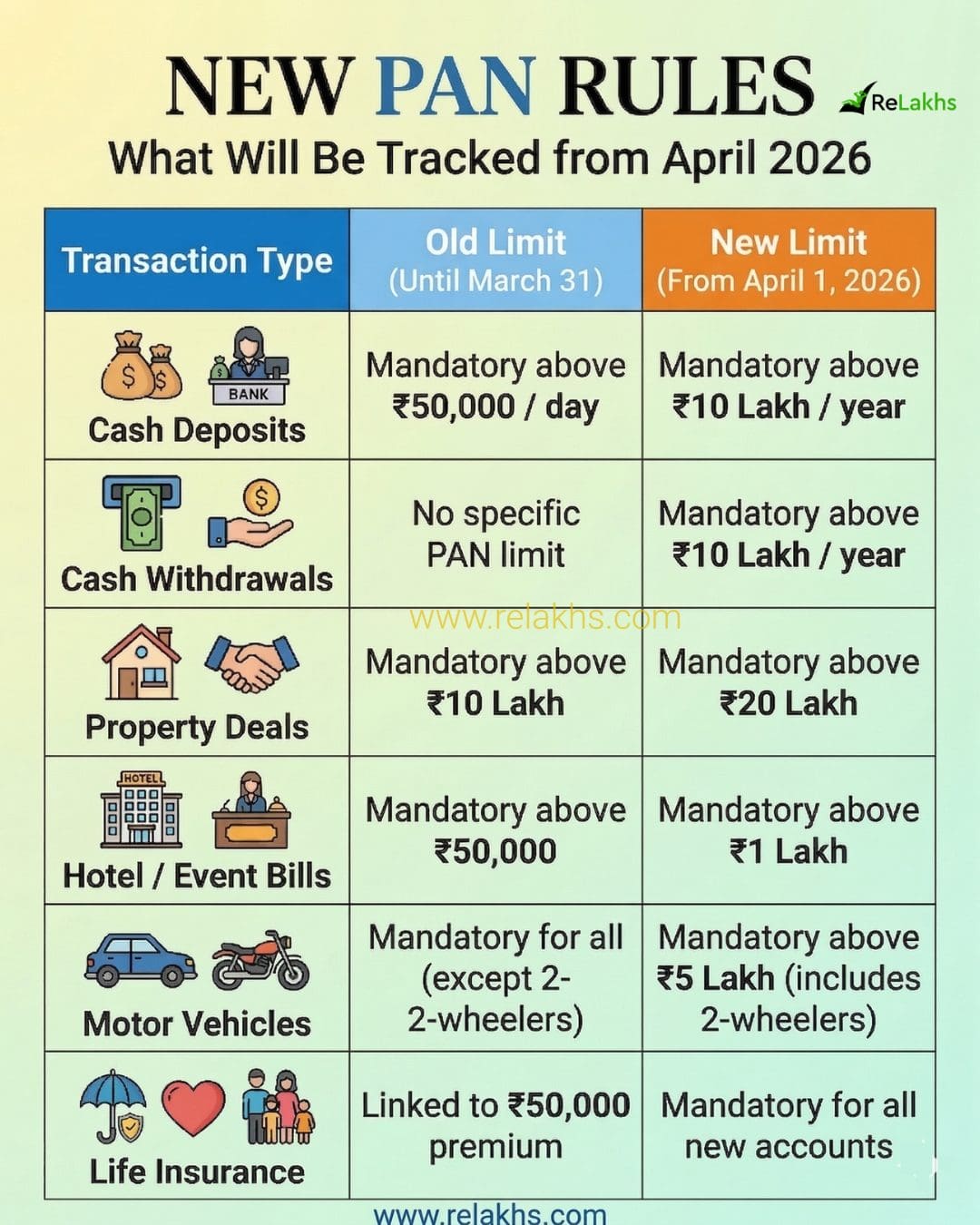
The 2026 rules move away from “transaction-based” monitoring to “aggregate-based” monitoring, giving a major breather for small, one-off cash expenses. Here is a breakdown of the new thresholds and how they change your financial daily life.
| Transaction Type | Old Limit (Until March 31) | New Limit (From April 1, 2026) |
| Cash Deposits | Mandatory above ₹50,000 / day | Mandatory above ₹10 Lakh / year |
| Cash Withdrawals | No specific PAN limit | Mandatory above ₹10 Lakh / year |
| Property Deals | Mandatory above ₹10 Lakh | Mandatory above ₹20 Lakh |
| Hotel / Event Bills | Mandatory above ₹50,000 | Mandatory above ₹1 Lakh |
| Motor Vehicles | Mandatory for all (except 2-wheelers) | Mandatory above ₹5 Lakh (includes 2-wheelers) |
| Life Insurance | Linked to ₹50,000 premium | Mandatory for all new accounts (at the time of policy issuance itself) |
| Jewelry / Bullion | ₹2 Lakh | ₹2 Lakh (No Change) |
Related Article: What to Do with PAN & Aadhaar After a Loved One’s Death in India?
New PAN Rules (2026) Explained
- Cash Deposits & Withdrawals: Under the old rules, depositing just ₹51,000 in cash required you to quote your PAN. From April 1, the taxman is looking at your annual aggregate. You can now deposit or withdraw smaller amounts freely, provided the total aggregate in a financial year does not cross ₹10 Lakh.
- Also, for transactions exceeding ₹20 lakh, simply providing a PAN number is no longer enough; the reporting entity (like a bank or registrar) must verify and authenticate the PAN details against government records.
A big relief, especially for small traders, farmers, and self-employed folks who handle regular mid-sized cash transactions.
- Real Estate Transactions: One of the most noticeable changes is in property transactions. Earlier, PAN was required if the property value exceeded ₹10 lakh. Now, this limit has been increased to ₹20 lakh. This means if you are buying a relatively smaller property, the compliance requirement becomes easier. This move clearly benefits middle-class buyers and reduces unnecessary paperwork in lower-value deals.
- Hotel & Restaurant Payments: There is some relief when it comes to spending on hotels and restaurants. Earlier, PAN was required for payments above ₹50,000. Now, this threshold has been increased to ₹1 lakh. This is helpful for occasions like family functions, events, or weddings, where bills can be high but not necessarily tax-related. For regular users, this means fewer compliance hassles.
- Vehicle Purchases: Another important change is related to vehicle purchases. From April 2026, PAN will be mandatory if the vehicle value exceeds ₹5 lakh. What’s new here is that this rule now also applies to high-value two-wheelers, not just cars. So if you are planning to buy a premium bike or an expensive car, PAN will definitely be required.
- Life Insurance Policies: In the case of life insurance, the earlier requirement was based on the premium amount. Now, PAN may be required right at the time of policy issuance, irrespective of the premium size. This change is more about tracking financial relationships rather than taxation, but it does mean slightly stricter compliance.
Whether your life insurance policy is ₹5,000 or ₹5 Lakh, if you are a new customer, the PAN is now mandatory.
FAQs on New PAN Rules 2026
Q1. What are the new PAN rules from April 2026?
PAN is required for higher-value transactions like property above ₹20 lakh, vehicles above ₹5 lakh, and hotel bills above ₹1 lakh.
Q2. Has the PAN limit for property increased?
Yes, it has been increased from ₹10 lakh to ₹20 lakh.
Q3. Is PAN required for buying a bike?
Yes, if the bike value exceeds ₹5 lakh.
Q4. Are small transactions affected?
No, smaller transactions have been given relaxation with higher thresholds.
While these limits offer a “breather,” they only apply if your PAN is valid. If your PAN-Aadhaar linking isn’t complete by now, your PAN will become ‘Inoperative’, leading to:
- Higher TDS rates.
- Inability to file ITR (Income Tax Return).
- A potential ₹10,000 penalty for misreporting.
As these rules come into effect from April 2026, there is no need to panic or overthink. For most people, there is actually some relief with higher limits. But at the same time, big-ticket transactions are now more visible than ever.
So going forward, it’s simple — keep your PAN updated, use it wherever required, and try to stay within the formal financial system.
Because in the new system — transparency is not optional, it’s expected.
Note: From April 1, 2026, you can no longer apply for a PAN card using only Aadhaar. Additional Proof of Date of Birth (like a birth certificate, Class 10 certificate, or passport) will be mandatory.
Continue reading:
- New Income Tax Rules 2026 | 10 Key Changes Explained
- 6 Banking Rules Every Bank Customer Should Know in 2026
- Latest TDS Rates Tax Year 2026-27 – Complete Chart
(Post first published on : 21-March-2026)
Join our channels