
We work hard, compromise on today’s comforts, and invest consistently for decades. Why? To secure our family’s future and protect our loved ones if we’re not around tomorrow. But what if the wealth you’re building so carefully never actually reaches your family?
According to the latest data consolidated from parliamentary disclosures, the Ministry of Finance, and institutional regulators, an astonishing ₹2.2 Lakh Crore is currently lying as “Unclaimed Money” across Indian banks, mutual funds, insurance companies, and provident funds.
This isn’t just a shocking number. It’s a quiet, generational wealth tragedy. When one generation earns and invests but doesn’t track or share where those investments are, that hard-earned money slowly becomes unclaimed and stuck with financial institutions, never reaching the family.
| Asset Class | Unclaimed Amount |
|---|---|
| Bank Deposits | ₹97,545 Cr |
| Post Office Deposits | ₹15,200+ Cr |
| Shares & Dividends | ₹89,004 Cr |
| Mutual Funds | ₹3,749 Cr |
| EPF | ₹10,915 Cr |
| Life Insurance | ₹20,062 Cr |
What Causes Financial Assets to Become Unclaimed?
Some of the most common reasons why financial assets become unclaimed are:
- Nominee details were never updated.
- Change of address, email ID, or mobile number.
- Forgotten investments made many years ago.
- Death of the investor without informing family members.
- Family members unaware of investments and financial accounts.
- Dormant or inactive bank and investment accounts.
- Lost physical share certificates and investment documents.
- Multiple job changes resulting in old EPF accounts being forgotten.
- Lack of a consolidated list of investments and financial assets.
- Failure to update KYC details with banks, insurers, or investment institutions.
Unclaimed Money & How to Trace and Reclaim Your Forgotten Investments
The good news is that unclaimed money is not lost forever. Whether it belongs to you or a family member, there are official portals and processes that can help you trace these forgotten financial assets and reclaim them.
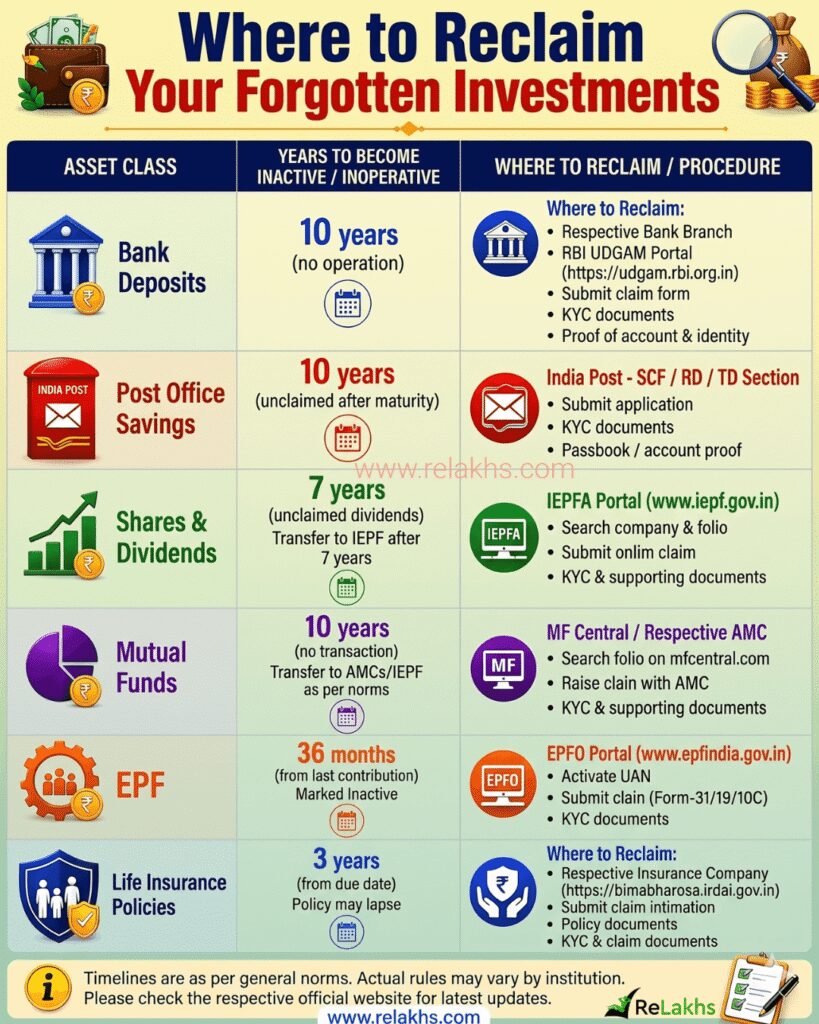
1. Bank Savings Accounts & Fixed Deposits
Where to search: RBI’s UDGAM Portal
The RBI has launched the UDGAM (Unclaimed Deposits – Gateway to Access Information) portal to help depositors search for unclaimed bank deposits across participating banks.
How to reclaim:
- Register on the UDGAM portal.
- Search using the account holder’s name along with PAN, Date of Birth, Voter ID, Passport Number, or other accepted identifiers.
- If a matching deposit is found, note the details and contact the respective bank.
- Complete the bank’s KYC and claim process to recover the funds.
2. Post Office Savings Schemes, NSC & KVP
Where to search: India Post Website and Head Post Offices
Unclaimed balances from Post Office Savings Accounts, National Savings Certificates (NSC), Kisan Vikas Patra (KVP), and other small savings schemes may eventually be transferred to the Senior Citizens’ Welfare Fund (SCWF).
How to reclaim:
- Check the “Unclaimed Amounts” or SCWF-related ledgers published by India Post.
- Search using the investor’s name, account number, or PAN, wherever available.
- If you possess old passbooks, NSC certificates, or KVP certificates, visit the Head Post Office where the account was originally opened.
- Request verification of the records and initiate the claim process.
3. Unclaimed Shares & Dividends
Where to search: Investor Education and Protection Fund Authority (IEPFA)
If dividends remain unclaimed for seven consecutive years, both the unpaid dividends and the underlying shares are transferred to the IEPF.
How to reclaim:
- Visit the IEPFA portal.
- Search using the company name, folio number, DP ID/Client ID, or PAN.
- File Form IEPF-5 online.
- Submit the required documents and coordinate with the company’s designated nodal officer.
- Once verification is completed, the shares and dividends may be restored to the rightful owner.
4. Mutual Funds
Where to search: MF Central
MF Central provides a consolidated view of mutual fund holdings across different Asset Management Companies (AMCs) and Registrars & Transfer Agents (RTAs).
How to reclaim:
- Log in to MF Central using your PAN.
- Review your Consolidated Account Statement (CAS).
- Check for unclaimed dividends, redemption proceeds, or forgotten folios.
- Contact the respective AMC or RTA if additional documentation is required to reclaim the funds.
5. Inoperative EPF Accounts
Where to search: EPFO Member Portal
EPF accounts can become inoperative when no contributions are received for an extended period after employment ends.
How to reclaim:
- Log in to the EPFO Member Portal.
- Ensure that your UAN is activated and linked with Aadhaar and your bank account.
- Locate old EPF accounts linked to your UAN.
- Submit an online transfer or withdrawal request through the EPFO portal.
6. Unclaimed Life Insurance Benefits
Where to search: Bima Bharosa Portal or Insurer Websites
Insurance companies are required to maintain records of unclaimed policyholder amounts, including maturity proceeds, survival benefits, and death claim payouts.
How to reclaim:
- Submit the required claim documents and identity proofs to initiate the settlement process.
- Visit the Bima Bharosa Portal or the insurer’s website.
- Search for unclaimed amounts using the policyholder’s name, date of birth, PAN, or policy number.
- Identify the insurer holding the funds.
How to Prevent Your Investments from Becoming Unclaimed
This is where you protect your family’s access to your hard-earned wealth.
Quick checklist:
- Update nominees regularly
- Maintain a simple investment master sheet
- Keep KYC updated
- Inform your spouse and children about your investments
- Consolidate old and dormant accounts
- Track old EPF accounts
- Digitize important documents like passbooks, certificates, and policy papers
Follow these steps, and you make it far easier for your family to access your wealth when they need it most.
Final Thoughts:
Unclaimed money is often not a financial problem but an information problem. In many families, wealth accumulated over decades remains inaccessible simply because nobody knows it exists. Taking a few simple steps today—updating nominees, maintaining records, and informing family members—can ensure that your hard-earned wealth reaches the people for whom it was intended.
Update (May 2026): A Single Portal to Search for Unclaimed Assets
The Government of India has launched unclaimedassetsportal.in, a common platform that brings together search facilities for unclaimed bank deposits, insurance policies, shares & dividends, and mutual fund investments.
Earlier, investors had to visit multiple portals such as UDGAM, IEPFA, MF Central, and insurer websites separately. The new portal acts as a single starting point to help citizens trace their forgotten financial assets more easily.
Continue reading:
- Investment Lock-in Periods & Withdrawal Rules Explained
- What to Do with PAN & Aadhaar After a Loved One’s Death in India?
- Nominee Vs Legal Heir : Who will inherit (or) own your Assets? | Importance of WILL
(Post first published on : 30-May-2026)
Join our channels




Hi Srikanth, I opened savings bank account in SBI, in 2002 year, during my post graduation. But very less amount is lying in that account and tried to claim the amount thru online in RBI UDAAN website. But website is showing nothing due to that savings account is not linked to PAN or Aadhaar etc. So it is not reflecting in RBI UDAN website. Is it possible to claim back that amount thru online….
Hi,
Yes, it may still be possible to recover the amount even if the account is not appearing in the UDGAM portal.
Since the account was opened long ago and may not have been linked to PAN, Aadhaar, or other identifiers, it may not show up in the UDGAM search results.
I suggest visiting any SBI branch with whatever details you have, such as the account number, passbook, identity proof, and address proof. The bank should be able to trace the account through its internal records and advise you on the claim and KYC process.
If you still have the old account number or passbook, it would make the search much easier.
Please do share your experience here after visiting the branch, as it may help other readers facing a similar situation.