
In my previous post, I have written about e-sahyog, an online facility provided by the Income Tax department for resolving mismatches with respect to Income Tax Returns.
A mismatch can happen if the data values provided by you in your Income Tax Returns do not match with the third party information on your income / investments / expenses. These third parties are banks, mutual funds, service tax department, sub-registrar of properties etc.,
In this post let us understand;
How the Income Tax department receives this information? Who provides this information to the IT department? What are the incomes that are reported to the IT department? What is the list of high value financial transactions that are reported to the department for FY 2020-21 / AY 2021-22? How to check if your high value financial transaction(s) are reported to Tax department?
List of High Value Financial Transactions reported to Income Tax Dept
With an aim to curb black money mess and to track high value cash transactions, the government has decided to implement new reporting guidelines w.e.f November 2016, March 2017 & Aug 2020. As per the govt’s notification, all goods & services providers have to report to the IT department about high value cash transactions & cash receipts.
Under the new norms, cash receipts, purchase of shares, mutual funds, immovable property, term deposits, sale of foreign currency will have to be reported to the tax authorities in a prescribed format, which is Form 61A.
- Immovable Property : The Registrar of properties will have to report purchase & sale of all immovable property exceeding Rs 30 Lakh to the Income Tax authorities.
- Professionals : The Professionals will be required to inform the tax department of receipt of cash payment exceeding Rs 2 lakh for sale of any goods or services.
- Cash Deposits in Banks : Banks will have to report cash deposits aggregating Rs 10 lakh or more in a financial year in one or more accounts (other than Current Account / Time Deposit) of a person.
- Term Deposits in Banks : Banks will have to report cash deposits aggregating Rs 10 lakh or more in a financial year in one or more Time Deposit accounts of a person (other than a time deposit made through renewal of another time deposit). These norms will also cover deposits and withdrawal made in Post Office Account.
- Deposits in Current Accounts : Cash deposits or withdrawals aggregating to Rs 50 lakh or more in a financial year in one or more Current Account of a person will have to be reported by the bank to the I-T authorities.
- Any cash payment of Rs 10 lakh or more in a financial year for purchase of bank drafts or pre-paid instrument issued by RBI will also be reported.
- Credit Card Bill Payments : If you make Credit Card bill payments of more than Rs 1 Lakh p.a in cash mode (or) Rs more than Rs 10 Lakh through Cheques / NEFT transfers etc.,
- Investments in Financial Securities : A company has to report receipt of Rs 10 lakh or more from a person/an investor in a financial year for acquiring bonds, debentures, shares or mutual funds (other than the amount received on account of transfer from one scheme to another scheme of that Mutual Fund).
- Cash Deposits during 9th Nov to 30th Dec, 2016 : Cash deposits during the period 09th November, 2016 to 30th December, 2016 aggregating to –
- (i) Rs 12.5 Lakh or more, in one or more current account of a person (or)
- (ii) Rs 2.5 Lakh or more, in one or more accounts (other than a current account) of a person.
In addition to the above list, quoting your PAN is now mandatory for many financial transactions. Based on this data also the IT department can track your financial transactions.
List of Third parties who report High value Financial Transactions
- Banks – They report High Value transactions related to deposits credit card payments.
- Mutual Fund Companies
- Companies issuing bonds or debentures
- Companies issuing shares
- Sub-Registrar offices on real-estate deals.
How do third parties report?
To keep a watch on high-value transactions by tax payers, the I-T department has developed a statement of financial transactions called Annual Information Return (AIR). On its basis, tax authorities will collect information on suspected high value transactions during a year.
(What is AIR ? – Annual Information Return (AIR) of ‘high value financial transactions’ is required to be furnished under section 285 BA of the Income-tax Act, 1961 by ‘specified persons’ in respect of ‘specified transactions’ registered or recorded by them during the financial year.)
Also, it is mandatory that all the specified entities (third parties) to furnish an AIR in respect of specified financial transactions registered or recorded by them during the Financial Year.
All the above third party establishments have your PAN details and they quote PAN details of all the high value financial transactions recorded by them in AIR. They submit AIR to the income tax authority.
In which report can I trace the High Value Financial Transactions?
You can check your Form 26AS under AIR section if any investment or expense has been categorized as a high value transaction. You can find high value financial transaction details under PART-E of your Form 26AS. Click here to access your Form 26AS.
For example – In the below image you can find that Just Dial company has filed AIR with the IT department indicating that the concerned Tax Assessee has purchased their equity shares worth more than Rs 1 Lakh during the Financial Year.

(Form-26AS gives you all the details of Tax credits. It is a form which indicates that the tax that has been deducted and has also been deposited with the Govt.) (Pic Courtesy – apnaplan.com)
New Form 26AS | New Format w.e.f 1st June 2020
The Central Govt has recently notified the changes to Form 26AS. Your tax passbook, i.e., Form 26AS, will now come with a new format, effective from 1st June, 2020.
Form 26AS will also have information about ‘Specified Financial Transactions‘ such as Stocks you have bought or sold, real estate transactions, payment details of credit card bills etc.
Latest Article (Aug 2020) : All you need to know about New Form 26AS | Annual Information Statement
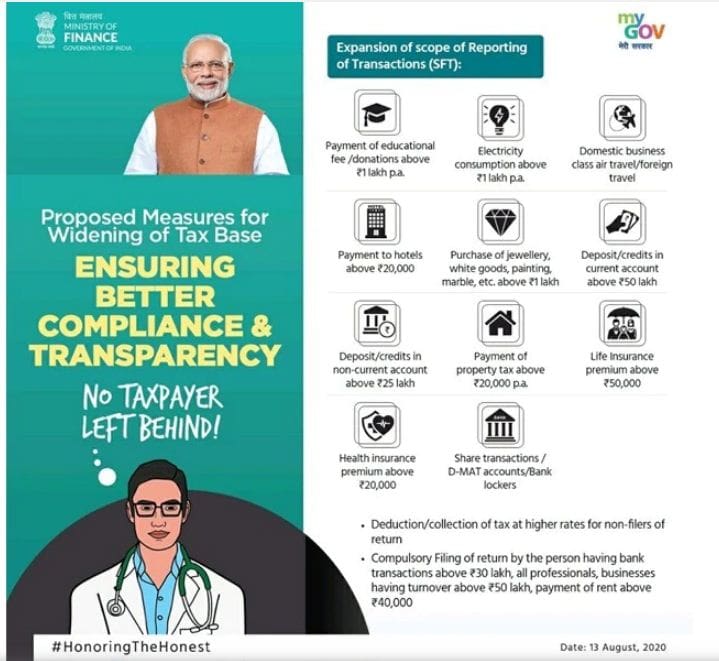
Newly Proposed Transactions under SFT & Form 26AS
The below newly proposed transactions (on 13-Aug-2020) would now be reflected in an individual’s tax account statement;
How to respond to the notices related to Non-Pan Transactions online?
In case if the Tax department finds discrepancies related to your high value transactions Vs your income tax return (or) if you have not quoted your PAN where it is required then they can issue non-PAN transaction related notices to you.
The notice contains details of the high value transaction and requests you to disclose if you own such transactions. The notice contains unique Transaction Sequence number (TSN) based on which you can respond to the non-PAN transaction notice online, on e-filing web-portal.
Below points give you information on ‘how to check non-pan transaction related notice and how to reply to such notices online’;
- Visit and login to e-filing portal.
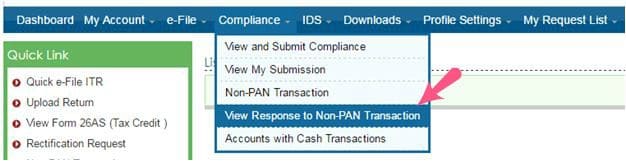
- Click on ‘Compliance’ menu option.
- Click on ‘Non-PAN transaction’ option.

- Key in your TSN (Transaction sequence number) in the ‘text box’ and click on ‘search’. You can view the details related to your high-value non-pan transactions.

- Click on ‘submit to view further details’ button.
- Based on the type of your transaction, you can find few options to choose from. For example, if the non-pan transaction is related to say mutual fund transactions then you can find options as below;
- Purchase of Mutual Fund is out of sources disclosed in the Income Tax Return.
- Part of the purchase of Mutual Fund is out of sources disclosed in the Income Tax Return.
- No such transaction was conducted.
- Want to avail the benefit of Income Disclosure Scheme, 2016.
- More time needed to submit response.
- You have to select one of the listed options and click on ‘submit’ button.
- You can view your response(s) by visiting ‘view response to non-pan transactions’ link under ‘Compliance’ menu option. You also have the option to revise your response.
How to reply to the notices related to High Value Cash Transactions online?
If substantial high value Cash transactions have been done in your Bank accounts, the IT dept may issue Compliance notice to you. You can respond to this notice online as below;
- Visit and login to e-filing portal.
- Click on ‘Compliance’ menu option.
- Click on ‘Accounts with Cash Transactions.
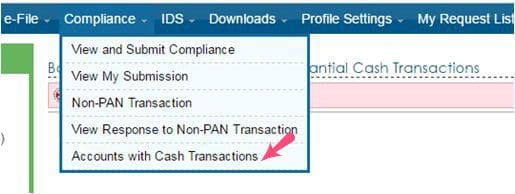
- The list of Bank Accounts with substantial Cash Transactions as communicated to you in the notice will get displayed on the screen. (Financial year – Bank Name – Account number – Response, will be displayed)
- You can click on ‘Submit’ button to provide your response.
- You have to select any one of the following options while submitting the response;
- Transactions in the account are considered in IT Return.
- Transactions in the account are considered in IT Return of another Account holder (joint-account).
- Transactions in the account are not considered in IT Return.
- Transactions in the account are partly considered in IT Return.
- Transactions in the account are not taxable or exempt (ex- Agricultural income)
- No relation with the Account.
- You also have the option to ‘revise’ your response after submitting it (if required).
Also, if you have made Cash deposits during 9th Nov, 2016 to 30th Dec, 2016, it is advisable to check the Compliance Section of your Income Tax e-Filing account.
If cash deposits are not in line with Tax-payer profile, such data is shown under Compliance section and concerned individual has to submit his/her response to such discrepancies.
1 – Visit Income Tax e-Filing Portal.
2 – Login with your credentials
3 – Click on Compliance menu option
4 – Select ‘Cash Transactions 2016‘ option
Ideally, you should see ‘No Records found’. As per the IT dept, the cash deposits information on the online portal is dynamic and will be updated on receipt of new information, response and data analytics. So, keep checking the compliance section once in a while over the next few weeks. (Post updated on 04-Feb-2017)
You may also receive an Email / SMS (if registered on e-Filing portal) from the dept, regarding Compliance notice (if any).
How to avoid receiving Income Tax notices on High Value Financial Transactions?
According to the Income Tax Authorities, transactions worth around Rs 12,000 crore form part of the Suspicious Transaction Report (STR) 2014-15, which is under probe.
It is often observed that many tax Assessees try to avoid showing their sources of income or tend to show less income in ITR to reduce their income tax liability. But, they do not know the fact that the IT dept might have complete knowledge about their financial transactions.
Therefore, it is better to declare all your sources of income and investments properly while filing your income tax return. Else, it may lead to adverse consequences.
Below are few tips to avoid getting tax notices on high value financial transactions;
- It is always better to file your ITR before the due date.
- Cross check all the TDS entries in your From 26AS. You may repeat this exercise once in a quarter.
- Check your Form 26AS if any transactions are reported under AIR section.
- Keep your PAN details up to date.
- Disclose the entire and correct income earned by you during the FY in your ITR.
- Keep a record of all your high value Financial transactions, investments & expenses
Continue reading :
- AY 2020-21 Income Tax Return Filing Tips | Which ITR Form should you file?
- Gold Investments Tax Treatment in India | Taxation rules on Gains from Selling Gold
- Income Tax Deductions List FY 2020-21 | New Vs Old Tax Regime AY 2021-22
(Image courtesy of Ppiboon at FreeDigitalPhotos.net)
Join our channels





Hi Sreekanth,
Nice article. got one query.
Me & my wife both are working and filling ITR from last 12 years. If we both withdraw 20 lacs each from our accounts and deposit back same 40 lacs after 4-5 years ,will there be any TDS, tax implications or IT notice ?
Thanks in advance.
Nice article.
I have a query. I was working abroad till Nov 2018 (3 years) and I have deposited above 10 lakh in my NRI account. I haven’t closed my NRI account when I moved back to India. I have to file my ITR for AY 2020-21 as I am currently working in an Indian institute from April 2019. My form 26AS shows SFT- 005 in part E with a remark “O” (for overbooked). What should I do to submit my ITR? I will be moving abroad again within a couple of months so I can’t close my NRI account now. Is it okay if I show the interest I received in the ITR during the financial year and pay the tax? Anything else I should do in this regard?
I would deeply appreciate your comment in this regard. Thank you.
Hello sir, good day
I am a marine engineer completed my nri status till 2018.But i have never filed ITR After that i have not joined my job till now.
In December 2018 i transferred 30lakhs INR to Turkey for purchase of property, but i could not buy apartment and thus the money was returned back to my nre account in February 2019 amounting to 42500 USD.
Now my PAN is flagged and i have received a message from IT DEPARTMENT
Dear A*** – Income Tax Department has received information about high value transactions relating to XXXXX6953X in FY 2018-19. However, as per records available, ITR for AY 2019-20 has not been filed. Please file your ITR by 30.9.2020. You can view transaction details and submit online response under e-Campaign tab on Compliance Portal – ITD
what is the step that i have to take?
As presently i am a resident indian because i have not been on ship since may 2018.
Kindly guide
Dear Anas,
You need to respond to the compliance notice through e-filing portal.
Suggest you to take help of a CA in this regard.
Related article : How to reply to Non-Filing of Income Tax Return Notice?
Hi,
I could see NRE FD renewed with term and new NRE FDs under SFT in Form 26AS. Is NRE deposits going to be reported. How this will have to be treated in ITR
Thanks
GGK
Dear GGK,
Yes, I think such Deposits (high value) will get reported under new Form 26AS Format.
Read : All you need to know about New Form 26AS | Annual Information Statement
As per Section 10(4)(ii), interest income earned on NRE account is exempt from tax if account holder is treated as a person resident outside India under Foreign Exchange Management Act (FEMA). Thus, taxability of interest earned on NRE FD account would depend on residential status of account holder under FEMA. Such interest would be exempt if account holder is a person resident outside India and taxable if he is a person resident in India in accordance with the provisions of FEMA.
HOW DO I ACTIVATE MY SBI SAVING ACCOUNT WHICH IS INOPERATIVE AS MORE THSN 1CRORE RUPEES TRANSFERED FROM INTRADAY TRADING.I HAVE SUBMITTED ALL RELATED DOCUMENTS AND TDS ALSO DEDUCTED FROM MY ACCOUNT BUT STILL ACCOUNT IS INACTIVE,I APPROACH TO BRANCH AND CORE BANKING SERVICE BUT THEY R ALSO NOT ABLE TO GIVE RESULT P[S, GIVE SOLUTIONS,
Dear SAURABH,
I am unable to understand your query..kindly rephrase it!!