With the introduction of the new Income-tax framework, Form 15G and Form 15H have now been replaced by Form 121.
From April 1, 2026, the Income Tax Department will roll out Form 121, a new unified self-declaration form that replaces familiar Form 15G and 15H. With this move, the department aims to make the TDS exemption process simpler by removing age-based distinctions and ensuring smoother digital compliance for taxpayers.
If you used to submit Form 15G/15H to avoid TDS on FD interest, PF withdrawal, or dividends — this update is important for you.
Form 121 (New Form 15G/15H): Complete Guide to Avoid TDS in 2026
Starting from the next tax cycle, the process for claiming TDS (Tax Deducted at Source) exemptions is undergoing a significant transformation. The familiar Form 15G and Form 15H are being replaced by a single, unified document: Form No. 121.
What is Form 121?
If your total income for the year is going to be NIL or below the taxable limit, you don’t need your bank or insurer cutting TDS on your earnings, right? That’s exactly where Form 121 comes in.
It’s a simple self‑declaration form you submit to the payer—like your bank, post office, or insurance company—to let them know your income isn’t taxable this year. Once you file it, they can skip deducting TDS on certain incomes such as interest, dividends, or insurance commissions.
To understand how and when to use Form 121 for the tax year 2026–27, here is a practical example involving interest income from a Fixed Deposit (FD).
The Scenario:
- Taxpayer: An individual (e.g., age 45) with no other significant source of income.
- Investment: A 3-year Fixed Deposit of ₹6,00,000 at a bank.
- Estimated Interest Income: ₹45,000 for the tax year 2026–27 (April 1, 2026, to March 31, 2027).
- Total Annual Income: ₹2,40,000 (which is below the taxable threshold, making the tax liability NIL).
Form 15G/15H vs Form No 121 – What Changed?
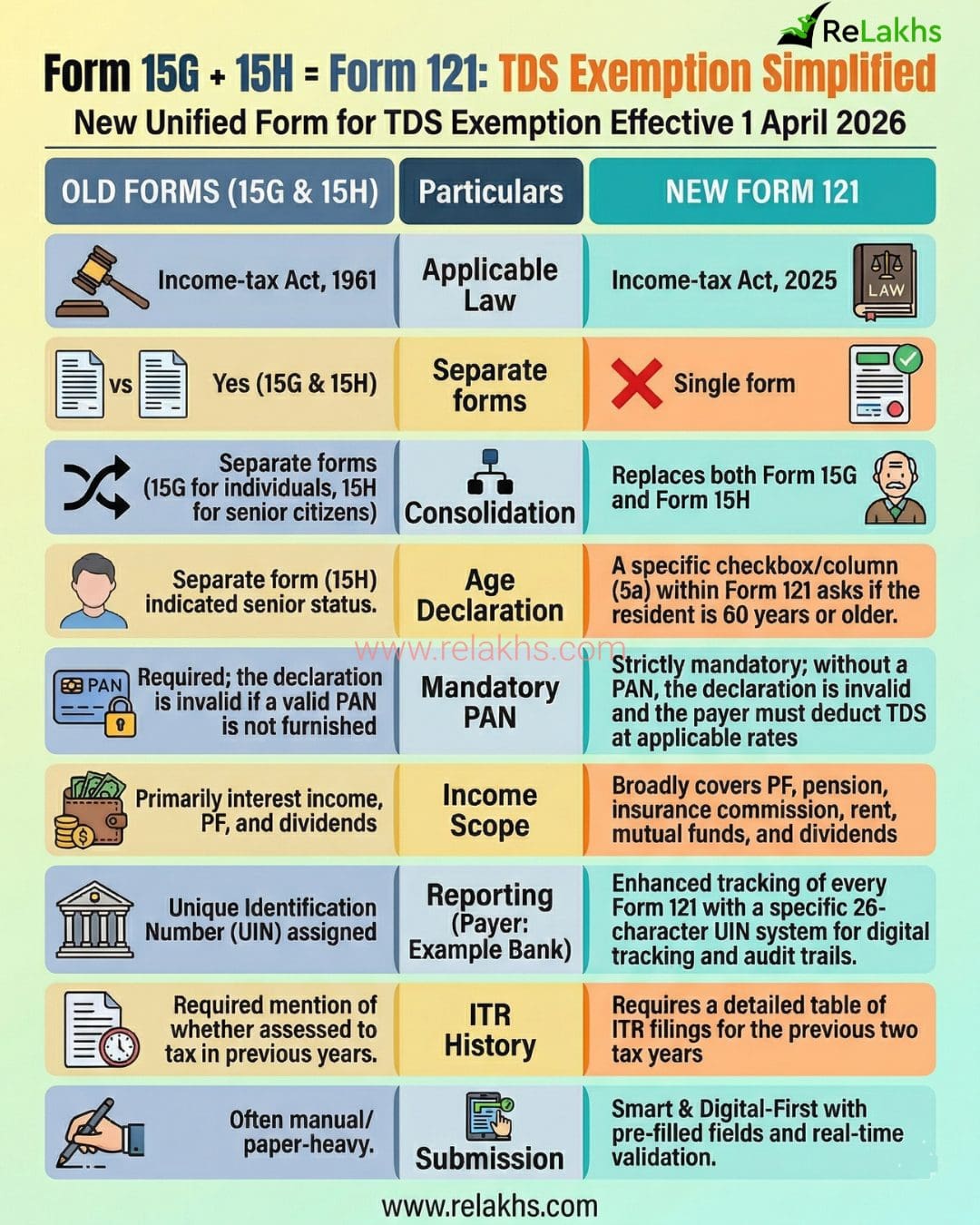
One major change you’ll notice is that the age-based distinction between forms is gone. Earlier, we had Form 15G for individuals below 60 and HUFs, and Form 15H for senior citizens. Now, both have been merged into a single, simplified Form 121 for everyone.
| Particular | Old Forms (15G/15H) | New Form 121 |
|---|---|---|
| Applicable Law | Income-tax Act, 1961 | Income-tax Act, 2025 |
| Separate forms | Yes (15G & 15H) | ❌ Single form |
| Consolidation | Separate forms (15G for individuals, 15H for senior citizens) | Replaces both Form 15G and Form 15H |
| Age Declaration | Separate form (15H) indicated senior status. | A specific checkbox/column (5a) within Form 121 asks if the resident is 60 years or older. |
| Mandatory PAN | Required; the declaration is invalid if a valid PAN is not furnished | Strictly mandatory; without a PAN, the declaration is invalid and the payer must deduct TDS at applicable rates |
| Income Scope | Primarily interest income, PF, and dividends | Broadly covers PF, pension, insurance commission, rent, mutual funds, and dividends |
| Reporting (Payer: Example Bank) | Unique Identification Number (UIN) assigned | Enhanced tracking of every Form 121 with a specific 26-character UIN system for digital tracking and audit trails. |
| ITR History | Required mention of whether assessed to tax in previous years. | Requires a detailed table of ITR filings for the previous two tax years |
| Submission | Often manual/paper-heavy. | Smart & Digital-First with pre-filled fields and real-time validation. |
Form 121 Sample for TDS Exemption (New 15G/15H Form)
To help you understand the new format better, here is a sample of Form 121, which has replaced Form 15G and Form 15H for claiming TDS exemption.
Form 121 is divided into two parts — Part A for the taxpayer and Part B for the payer. Let’s break it down simply!
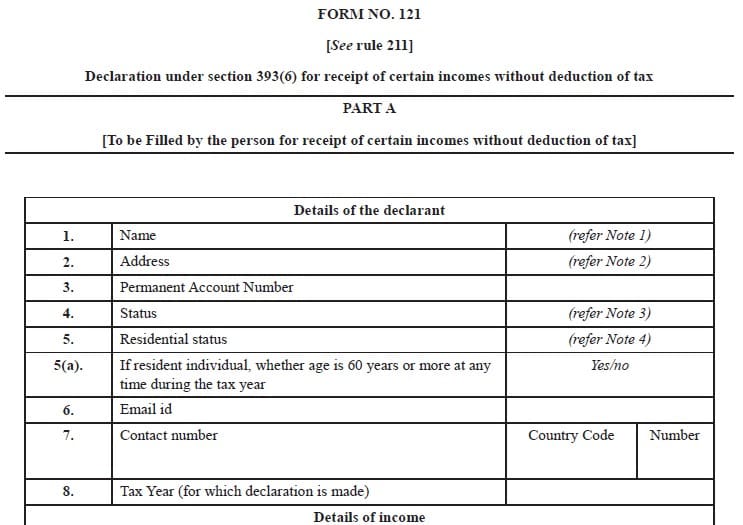
Part A – To be filled by the taxpayer
This is where you enter your basic details — name, PAN, residential status, and contact information. Along with that, you’ll also declare:
- The nature of income (like interest, dividend, or rent)
- The estimated income for which you’re making the declaration
- Your total estimated income for the financial year
- Any previous Form 121 submissions, if applicable
- ITR details for the last two assessment years
The most important declaration in the form confirms that:
- Your total tax liability for the year is NIL
- Your income does not exceed the basic exemption limit (with special consideration for senior citizens)
Part B (To be filled by payer)
This section is completed by the bank or institution paying the income to you. It includes:
- Payer’s TAN, PAN, and contact details
- Unique identification number of the declaration
- Transaction Details: Amount of income paid/credited and the date of receipt of the declaration.
FAQs on Form 121 for TDS Exemption
- Who is eligible? Resident individuals (all ages) and HUFs are eligible. Companies, firms, and non-residents cannot use this form.
- What incomes are covered? It covers PF withdrawals, pensions, insurance commissions, rent, interest on deposits, mutual fund income, and dividends.
- Can I file Form 121 online? Yes, it can be submitted in paper form or online if the payer provides that facility.
- What are the consequences of false statements? Any person making a false statement is liable for prosecution under Section 482.
- When to File Form 121?
- Submission time: Make sure you submit Form 121 to your payer before the transaction takes place — that is, before the income is credited or paid. Submitting it on time ensures that TDS isn’t deducted in the first place.
- Frequency: You’ll need to file a fresh Form 121 every financial year. The declaration doesn’t automatically carry forward to the next year.
- Multiple payers: Have income from more than one source — say, multiple banks or institutions? You’ll need to submit a separate Form 121 to each payer where you’re earning income like interest or dividend.
- Is providing a PAN mandatory? Absolutely yes — quoting your PAN (Permanent Account Number) is compulsory while submitting Form 121.
- What happens if I don’t have a PAN? Providing a PAN is mandatory. If you do not furnish a valid PAN, the form will be considered invalid, and the payer must deduct tax at the full applicable rate.
- Can everyone use Form 121? Not really. Form 121 is meant only for taxpayers whose total income for the year is likely to be NIL — meaning it falls below the taxable limit. If you meet these conditions and want to avoid TDS on your income, you can submit this declaration. Remember, Form 121 must be filed separately for each tax year, as it doesn’t carry forward automatically.
- What are the modes of submission of the Declaration in Part A of Form No. 121 by the declarant? You can submit Form 121 either in paper form or online, depending on what your payer (like your bank, post office, or insurance company) allows.
Final Thoughts
Form 121 is the new and improved version of Form 15G/15H — now more transparent and easier to track.
- One single form for all taxpayers
- More details for better accuracy
- PAN and income declaration made mandatory
If your income is below the taxable limit, this form helps you avoid TDS and the trouble of claiming refunds later. If TDS still gets deducted, you can claim it back while filing your ITR.
Continue reading:
- Latest TDS Rates Tax Year 2026-27 – Complete Chart
- Income Tax Deductions FY 2026-27: Complete Guide to Old vs New Tax Regime
- New PAN Rules from April 2026: Limits & Impact
(Post first published on : 30-March-2026)
Join our channels