
Terms like “Retirement Fund” and “Children’s Plan” sound comforting and reassuring. They make us feel safe. But in personal finance, that comfort often comes at a cost.
A mutual fund with “Retirement” in its name isn’t necessarily the smartest way to prepare for retirement. In the same way, a life insurance policy labeled as a “Children’s Plan” isn’t automatically the best option for your child’s future.
In fact, many costly financial mistakes happen when long-term savings are tied up in products that sell more on their names and marketing than on actual suitability.
A good investment isn’t defined by the label on it. It’s defined by whether it fits your goal, uses the right asset allocation, keeps costs under control, delivers reasonable returns, and provides the risk coverage you actually need.
Children’s Insurance Plans Case Study & Costly Mistakes
Let’s look at real examples.
Illustration 1: LIC Children’s Money Back Plan (Plan 732)
On the surface, this life insurance plan look like the choice a responsible parent would make. In reality, though, the underlying structure and numbers reveal a very different picture.
Key Policy Inputs (Indicative)
- Annual Premium: ₹1,00,000
- Policy Term: 20–25 years
- Total Premium Paid: ₹20–25 lakh
- Sum Assured: ~₹10–15 lakh
The Biggest Flaw: Life Cover Is on the Child’s Name
This is one of the most serious—and least discussed—issues. In LIC Children’s Money Back Plan, the life assured is the child, not the parent, which makes little sense from a financial planning perspective.
From a financial planning perspective, this makes no sense.
- The biggest financial risk is the earning parent’s absence
- The child is financially dependent
- Yet the insurance cover is placed on the child’s life
If the parent is no more:
- Premiums may be waived
- Policy may continue
- But the sum assured remains small
- There is no meaningful lump sum when it’s needed the most
This does not protect education goals. It merely postpones the financial problem. And if something happens to the child (emotionally tragic, but financially):
- There is usually no large financial liability
- Yet this is the risk the plan chooses to insure
Insurance should always be on the income generator, not the dependent.
Returns Reality (XIRR)
Based on LIC’s own benefit illustrations, the numbers tell a worrying story. The expected XIRR is only around 4.5%–5.5%, and once you factor in tax and inflation, the real return drops to near zero or even negative.
Meanwhile, real-world costs are rising much faster: general inflation hovers around 6%–8%, and education inflation in India is closer to 15%–20%. This mismatch guarantees a steady loss of purchasing power over time. It is not prudent or safe planning; it is wealth erosion packaged and sold as a children’s plan.
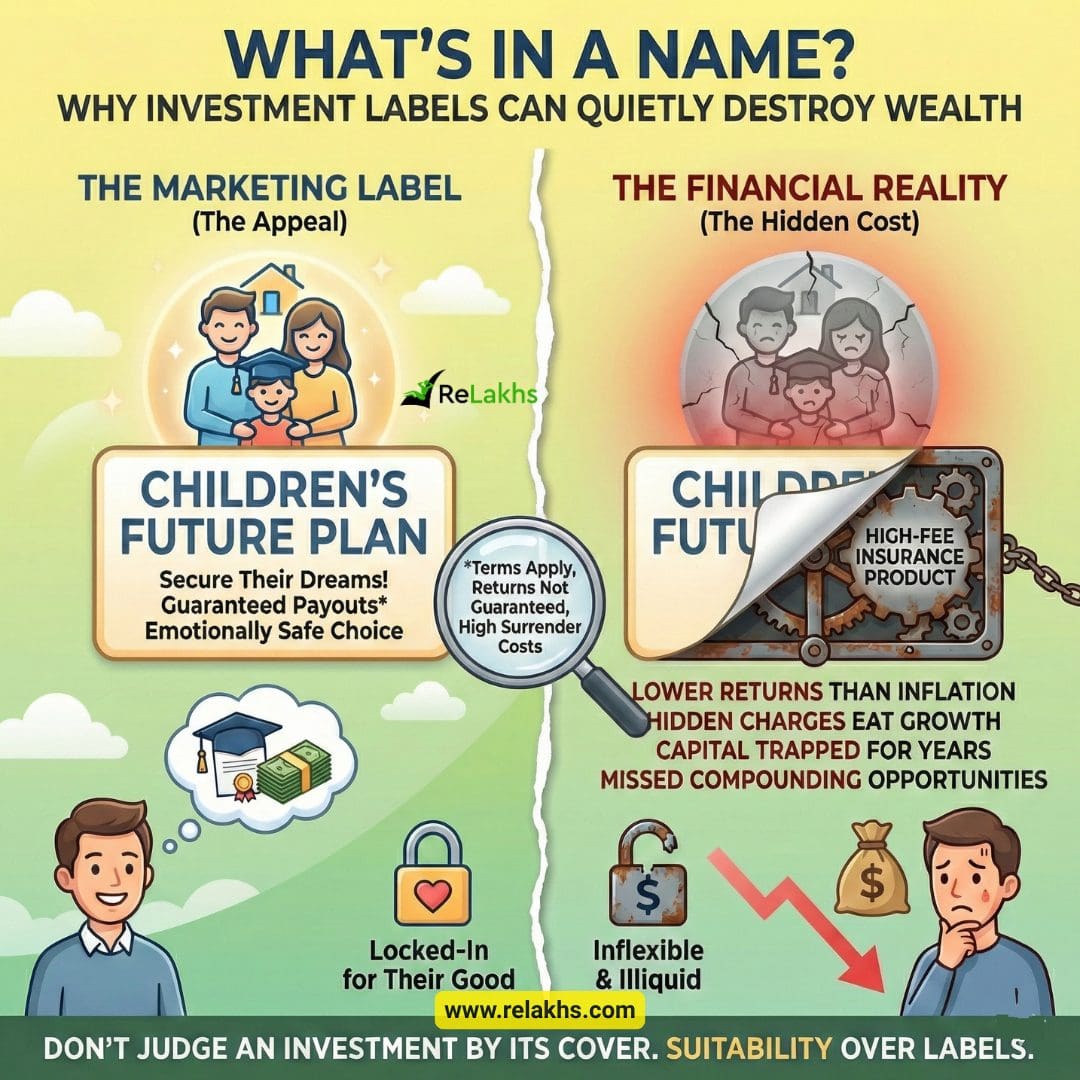
Illustration 2: SBI Life – Smart Future Star
Another popular child-focused insurance product. Let’s again ignore the branding and look at the math.
Key Policy Inputs (Indicative)
- Annual Premium: ₹1,00,000
- Policy Term: 20 years
- Total Premium Paid: ₹20 lakh
- Life Cover: ~₹12–15 lakh
Protection check
- For a parent earning ₹10–15 lakh annually, the required life cover is often in the ₹1–2 crore+ range.
- This plan offers only a fraction of that, leading to underinsurance.
- The trade-off is: low protection, high premium commitment, and long lock-in.
- The result is a false sense of security rather than genuine financial safety.
Premium illustration and XIRR
- Expected maturity value in an optimistic scenario: roughly ₹30–35 lakh.
- Implied XIRR: around 5%–6%.
- After inflation, the real (inflation-adjusted) return turns negative.
- Returns fall far short of both education inflation and long-term wealth-creation requirements.
The Real Cost of Name-Based Decisions
When insurance and investment are mixed:
- Insurance becomes insufficient
- Investment becomes inefficient
- Costs eat into compounding
- Flexibility is lost for decades
The product name sounds right. The financial outcome is wrong. This is marketing-led planning, not goal-led planning.
What a Truly Responsible Parent Should Do?
A truly responsible parent should start by asking two basic but powerful questions.
First, if I am no longer around, does my family have enough life cover to sustain the loss of my income and continue meeting all financial obligations without compromise? Adequate life insurance is not about comfort or product names—it’s about ensuring stability when it’s needed the most.
Step 1: Get Adequate Life Insurance (Non-Negotiable)
Buy a pure term life insurance policy on your name (parent).
- Calculate your child’s future education cost
- Adjust for 15–20% education inflation
- Add household expenses and liabilities
- Include this in your sum assured requirement
This ensures that if you are no more, your child’s future is fully funded.
Second, am I investing in options that can genuinely beat inflation and grow my money over time to meet future goals like my child’s education and long-term needs? Savings that fail to outpace inflation may feel safe today, but they quietly fall short tomorrow. Responsible planning means choosing investments that have the potential to grow meaningfully and keep up with rising costs.
Step 2: Invest Separately in Growth Assets
Once protection is in place, plan investments independently.
- Start early—even with small amounts
- Use growth assets like equity mutual funds and long-term savings products like Public Provident Fund
- Maintain proper asset allocation
- Keep costs low
- Review periodically
Over long periods, growth assets have the potential to beat both general and education inflation—something traditional children’s insurance plans simply cannot do.
Final Thought:
If a product’s name genuinely reflects its structure and outcome—great. But most of the time, names are emotional hooks, not financial solutions.
Before locking your money for 20–25 years, always ask:
- Who is insured—and for how much?
- What is the real XIRR?
- Does this beat inflation?
- Is this the best investment option for this goal?
Because in personal finance, numbers matter more than narratives.
Ever bought a children’s plan? What made you choose it — the name, the promise, or the numbers?
Continue reading:
- Term Insurance : Is it just a waste of your money?
- How much Term Life Insurance Cover do I need? | Online Insurance coverage Calculator
- Best Mutual Funds for 2026: Picking “Consistency Kings” Over Performance
- Engineering vs Medicine: The Eternal Dilemma in Your Child’s Education
Disclaimer: This post is for informational and educational purposes only. The life insurance products referenced are used solely for illustration and do not constitute a recommendation or criticism of any specific insurer. Similar traditional and children’s life insurance plans are offered by other insurers, and the analysis discussed broadly applies to such products as well. Readers should assess suitability based on their individual financial goals and circumstances.
(Post first published on : 11-Feb-2026)
Join our channels