
They say parents are our first teachers — and for me, that couldn’t be truer.
I lost my father at a very young age. He passed away in an accident while on official duty at a PSU bank. Life changed overnight for our family. But even in his absence, his decisions continue to speak. And my mother — with her quiet strength — ensured those lessons stayed alive in our daily life.
These were not lessons from textbooks.
They were lessons from lived experience.
From long-term thinking to living within my means, these lessons have not only shaped my financial habits but also my outlook on life.

From My Father: Think Long Term, Act With Conviction
One of the strongest lessons I inherited from my father was his long-term view of life. He didn’t chase quick gains or follow momentary trends. Instead, he focused on smart, disciplined decisions — even when the path wasn’t easy or obvious.
Taking Risks When It Truly Matters
My father was not afraid to take a risk when it was required. He was an early believer in the value of equities — way before access to stock markets became mainstream. At a time when investing in equities (1980s) was neither common nor easily accessible, he invested in stocks — including Dhanuka shares.
There were no online platforms, no YouTube channels, no easy demat access. Investing required effort, conviction, and courage. That alone shows his willingness not just to dream — but to act.
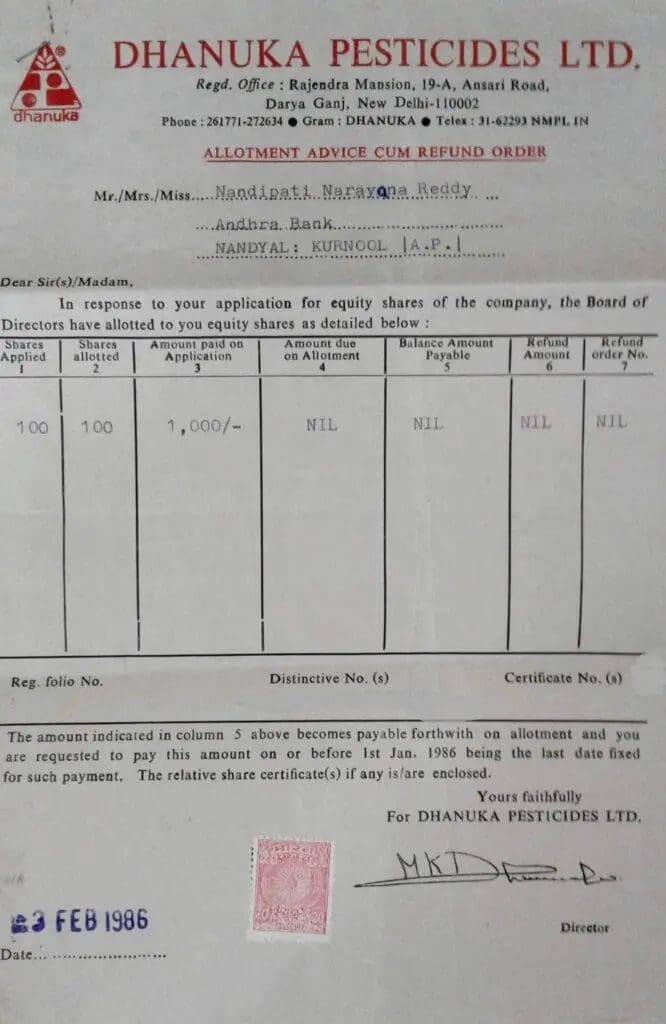
I still hold those Dhanuka shares today.
Decades later, they remain part of our family portfolio. Not out of emotion, but out of respect for long-term conviction.
Real Estate: Grow Within Your Capacity
He also invested in real estate — not aggressively, not beyond his means — but within what he could afford. And we continue to hold those properties even today.
No over-leverage, no speculative trades — just patient ownership. Years later, when I wrote on Relakhs about the importance of maintaining a long-term investment horizon, I realized I wasn’t simply articulating an idea; I had witnessed it being practiced every day at home.
When Life Took an Unexpected Turn
My father was working in a managerial cadre in a PSU bank when he passed away. After his death, my mother was offered a job in the same bank on compassionate grounds.
Because she had studied only up to PUC, she was appointed in a clerical grade — much lower than my father’s position.
We received the bank’s corporate insurance claim and accidental insurance proceeds. That financial support, combined with my father’s investments and my mother’s discipline, helped stabilize our family during a difficult period.
She did not misuse the money.
She did not change our lifestyle suddenly.
She did not make emotional financial decisions.
She protected the foundation — savings, simple living, long-term assets. And she focused on one priority: ensuring that both my sister and I received good education.
Looking back, I now understand — because the basics were right, recovery was possible.
From My Mother: Live Within Your Means
What I learned from her is something many people overlook in our fast-paced, credit-driven world. My mother says something very simple:
“If you are taking a loan, you are not worth it.”
What she meant was not that loans are always wrong. What she meant was — do not buy what you cannot afford. Do not build a life dependent on borrowed money.
This mentality taught me financial discipline that many adults still struggle with — living below your means and avoiding unnecessary obligations. If there is one mantra from my mother that I carry with me today, it is this:
Live Within Your Means..!
Her philosophy was grounded in dignity — avoid unnecessary debt, live within your means, and never compare/measure your life against someone else’s. In today’s world of easy credit, endless EMIs, and “buy now, pay later” temptations, this principle feels more relevant than ever.
What Personal Finance Truly Means to Me
Looking back now, I see how both my parents — each in their own way — taught me important truths:
From my father, I learned:
- The importance of a long-term view.
- Taking calculated risks when necessary.
- Investing in growth assets.
From my mother, I learned:
- Avoiding unnecessary debt.
- Living within one’s means – Live simply. Spend consciously.
- Protecting stability – Value stability over show
One prioritized growth, while the other focused on protection. Together, they created a sense of balance — a balance that ultimately shaped my understanding of personal finance.
Even though my father is no longer here, and even though my mother’s formal education was limited, their wisdom continues to guide my decisions — financially and personally.
Today, I often tell my clients, friends, and readers:
Real financial planning isn’t about how rich you can become — it’s about ensuring you don’t become poorer when life takes an ugly turn.
Money can always be earned again if the foundation is strong. But when that foundation is weak, rebuilding can take years — sometimes an entire lifetime. My financial education didn’t start with certifications or books; it started at home.
I hope these lessons make you pause and reflect on your own journey. Sometimes the greatest financial wisdom does not come from markets or money — it comes from watching how our parents handled life.
Their quiet discipline.
Their sacrifices.
Their long-term thinking.
Those are the foundations we stand on today.
Continue reading:
- My Latest Mutual Fund Portfolio 2025-26 | 16 years of MF Journey & Lessons Learned
- Are you Saving for your Cash, Care & Crash Funds?
- My Latest Stock Portfolio 2025-26 | Equity Investments (Shares)
(Post first published on : 16-Feb-2026)
Join our channels