
The notification of the Income-tax Rules, 2026 on March 20 brings the most significant change to HRA in over three decades. While the basic calculation formula remains the same, the classification of “Metros” and the transparency requirements have been completely overhauled.
From April 1, 2026, the House Rent Allowance (HRA) rules have been updated to improve transparency and compliance. While the calculation method remains unchanged, several key updates have been introduced.
Key changes in HRA rules 2026
- No change in HRA calculation formula
- More cities classified as metro (50% salary limit applies)
- New Form 124 replaces Form 12BB for declaration
- Mandatory disclosure of landlord relationship
- Stricter verification and digital tracking of claims
- HRA exemption still available only under old tax regime
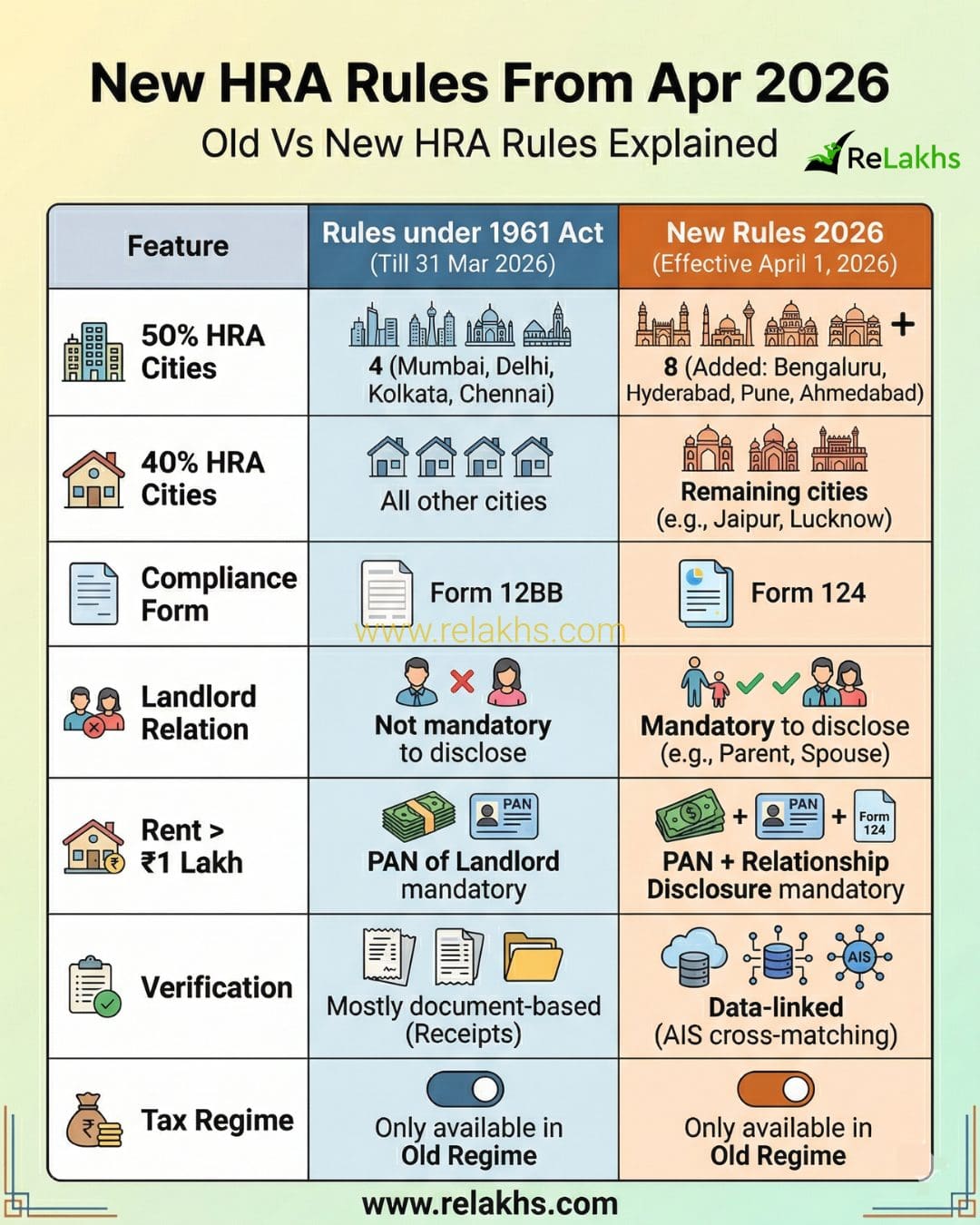
New HRA Rules 2026 | Key Updates Explained
| Feature | Rules under 1961 Act (Till 31 Mar 2026) | New Rules 2026 (Effective April 1, 2026) |
| 50% HRA Cities | 4 (Mumbai, Delhi, Kolkata, Chennai) | 8 (Added: Bengaluru, Hyderabad, Pune, Ahmedabad) |
| 40% HRA Cities | All other cities | Remaining cities (e.g., Jaipur, Lucknow) |
| Compliance Form | Form 12BB | Form 124 |
| Landlord Relation | Not mandatory to disclose | Mandatory to disclose (e.g., Parent, Spouse) |
| Rent > ₹1 Lakh | PAN of Landlord mandatory | PAN + Relationship Disclosure mandatory |
| Verification | Mostly document-based (Receipts) | Data-linked (AIS cross-matching) |
| Tax Regime | Only available in Old Regime | Only available in Old Regime |
1. The “Big 8” Metro Expansion
For years, taxpayers in tech hubs like Bengaluru and Hyderabad were capped at a 40% exemption despite having higher rents than some traditional metros.
- Impact: If you live in Bengaluru, Hyderabad, Pune, or Ahmedabad, your “ceiling” for HRA exemption increases by 10% of your basic salary. This could result in tax savings of ₹20,000–₹60,000 annually for mid-to-high-income earners.
2. Introduction of Form 124
The old Form 12BB is retired. The new Form 124 is more than just a name change; it is designed for data matching.
- Relationship Tagging: You must now explicitly state if your landlord is a relative.
- The Goal: To identify circular transactions where rent is “paid” to a family member but never actually transferred or declared as income by the receiver.
3. Stricter “Family Rental” Scrutiny
Renting from parents is still perfectly legal, but the new rules make it “high-visibility.”
- What you must do: Ensure the rent is paid via bank transfer. Since you now declare the relationship in Form 124, the tax department’s AI will automatically check if your parent has reported that same amount as “Rental Income” in their own ITR.
4. The Calculation Reminder
The “least of the following” formula remains the core of the calculation for those under the Old Tax Regime:
- Actual HRA received from your employer.
- Rent paid minus 10% of your Basic (+DA).
- 50% of Basic (if in the 8 cities) or 40% of Basic (elsewhere).
Key Takeaway
The HRA benefit remains the same, but the way you claim it is becoming more structured and transparent. Earlier, it was relatively easy to claim HRA with minimal checks. From April 2026, it will still be easy — but only if your documentation is genuine and complete.
If you are planning to claim HRA going forward, ensure that your rent payments are real, properly documented, and clearly reported. Especially in cases involving family members as landlords, maintaining proper records will be crucial to avoid issues later.
Continue reading:
- New Income Tax Forms 2026: Full List & Form Numbers Explained
- New PAN Rules from April 2026: Limits & Impact
- New Income Tax Rules 2026 | 10 Key Changes Explained
(Post first published on : 21-March-2026)
Join our channels