If you have recently seen headlines saying “UPI charges are coming”, you may be wondering:
Will I now have to pay a fee every time I use UPI? The short answer is No — there is no direct UPI transaction fee for consumers.
However, from October 15, 2026, a new Merchant Discount Rate (MDR) will apply to certain UPI merchant transactions. The important part is understanding who pays the MDR, which transactions are covered, what the caps are, and whether consumers could eventually feel an indirect impact.
Let’s break it down.
What is MDR?
MDR stands for Merchant Discount Rate. It is a fee associated with accepting a digital payment. Under the new UPI framework, MDR will be charged within the merchant payment ecosystem and shared among participating banks, payment service providers and UPI application providers.
Importantly, MDR is not a tax collected by the Government or NPCI.
For example, suppose a customer purchases a product worth ₹50,000 and pays through UPI.
At an MDR of 0.4%: ₹50,000 × 0.4% = ₹200
The customer does not pay ₹50,200. The ₹200 MDR is a charge within the payment ecosystem.
UPI MDR Rates From October 15, 2026
The MDR is not the same for every type of transaction.
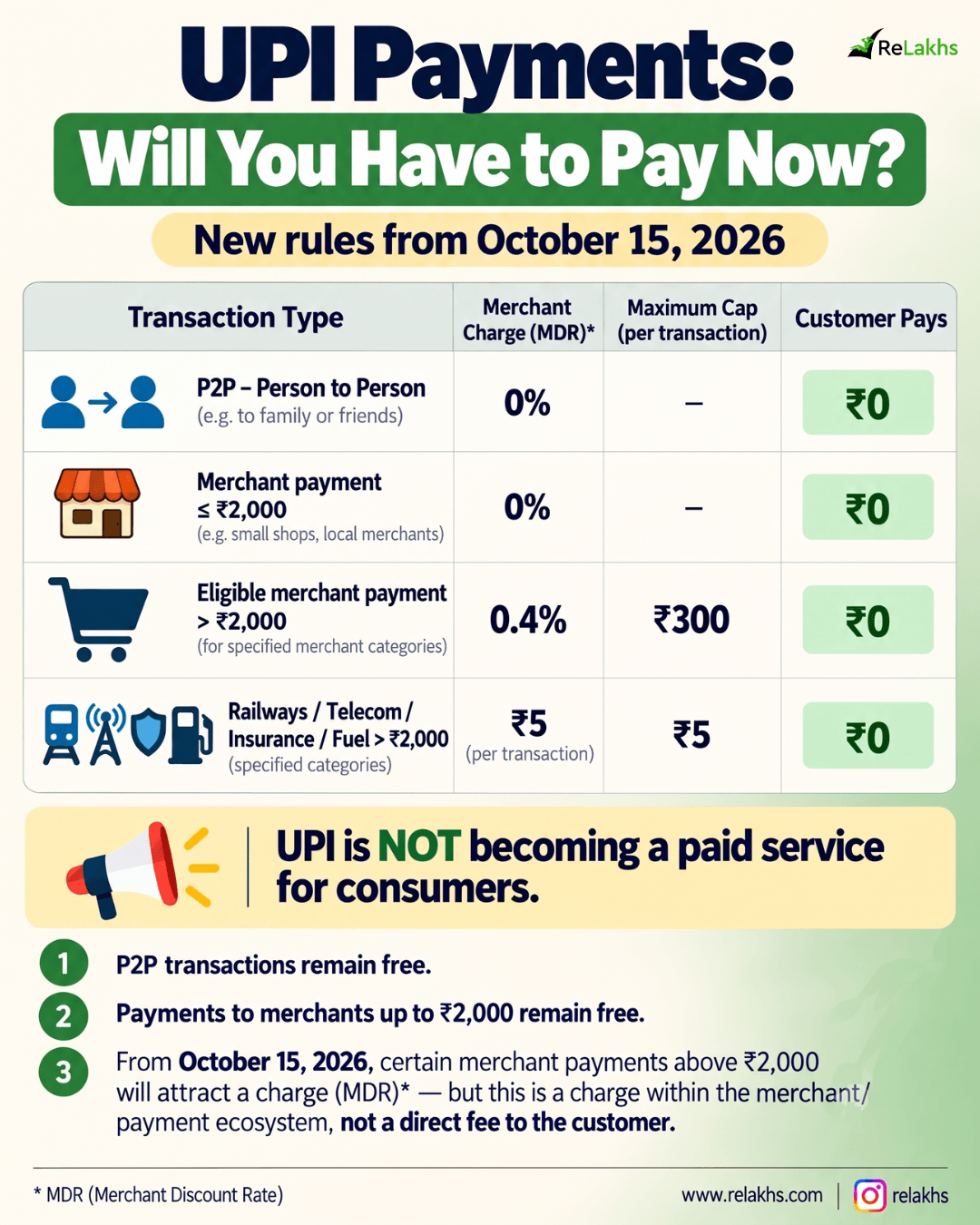
| Transaction Type | MDR | Maximum Cap | Customer Pays Directly |
|---|---|---|---|
| P2P – Person to Person | 0% | — | ₹0 |
| Merchant payment up to ₹2,000 | 0% | — | ₹0 |
| Eligible merchant payment above ₹2,000 | 0.4% | ₹300 | ₹0 |
| Railways / Telecom / Insurance / Fuel / Agricultural inputs above ₹2,000 | ₹5 per transaction | ₹5 | ₹0 |
| Mutual funds / Securities / Stockbrokers / Dealers | 0.02% | ₹300 | ₹0 |
These rates are part of the revised framework announced for implementation from October 15, 2026.
What does the ₹300 cap mean?
For normal eligible merchant transactions above ₹2,000, the MDR is 0.4%, but it is capped at ₹300 per transaction.
For example:
- ₹10,000 payment → MDR = ₹40
- ₹50,000 payment → MDR = ₹200
- ₹75,000 payment → 0.4% would be ₹300
- ₹1,00,000 payment → MDR would still be ₹300, because of the cap.
So, the ₹300 is not a limit on the transaction value. It is the maximum MDR payable on an eligible transaction.
Why is there a separate ₹5 category?
Certain essential and relatively thin-margin sectors have been placed under a separate flat-rate structure.
For eligible payments above ₹2,000 involving categories such as:
- Railways
- Telecommunications
- Insurance
- Fuel
- Agricultural inputs
the MDR is ₹5 per transaction, rather than 0.4%. So, for example, an eligible ₹10,000 railway payment would attract an MDR of ₹5 within the payment ecosystem, not ₹40.
What about Mutual Funds and Stocks?
There is another important category that many headlines may miss. Payments relating to mutual funds, securities, stockbrokers and dealers will attract a much lower MDR of 0.02%, capped at ₹300 per transaction.
For example: ₹1,00,000 mutual fund investment × 0.02% = ₹20 MDR
This is significantly lower than the standard 0.4% rate.
What about SIPs through UPI AutoPay?
There is an important distinction here. The new MDR framework applies to specified UPI payment transactions. UPI mandates/AutoPay transactions are outside the prescribed MDR charge, according to reporting on the framework.
Mutual fund SIPs paid through UPI AutoPay/UPI Mandates will not attract the prescribed MDR. However, one-time mutual fund payments made through UPI will fall under the 0.02% MDR category, capped at ₹300 per transaction.
| Mutual Fund payment method | MDR from Oct 15, 2026 |
|---|---|
| SIP through UPI AutoPay / Mandate | No prescribed MDR |
| One-time mutual fund payment through UPI | 0.02%, capped at ₹300 |
Small Merchants Get an Exemption
Another important provision is for small merchants. Small merchants receiving up to ₹1 lakh per month through UPI QR codes under the Person-to-Person-Merchant (P2PM) category will continue to enjoy zero MDR.
This is particularly relevant for street vendors, neighbourhood shops and other small businesses.
So, the new MDR framework is not simply: “UPI above ₹2,000 = everyone pays 0.4%.”
There are different categories and exemptions.
Does the Customer Pay the MDR? What About Indirect Impact?
This is probably the most important question. The MDR is not directly deducted from the customer’s bank account. The Government has also advised banks to ensure that merchants do not pass the MDR directly on to customers.
For example, if you make a ₹50,000 eligible purchase:
Purchase value = ₹50,000
MDR @ 0.4% = ₹200
Amount you pay = ₹50,000
However, MDR is still a business cost.
Even though merchants cannot explicitly add it as a UPI surcharge at checkout, businesses may manage the additional cost through their overall pricing, margins or payment-related discounts. This means there could be an indirect impact on consumers over time.
That does not mean every merchant will increase prices by 0.4%. It simply means the direct impact is ₹0, while an indirect impact is possible. This is something worth watching once the new framework starts operating.
A Few Important Points to Remember
1. P2P UPI remains completely free : If you are transferring money to another individual, there is no MDR — irrespective of the amount transferred.
2. UPI payments up to ₹2,000 remain free : Eligible merchant payments up to ₹2,000 continue to have zero MDR.
3. Not every merchant payment above ₹2,000 attracts 0.4% : There are specific categories, including capital-market transactions and essential sectors, that have different MDR rates.
4. ₹300 is an MDR cap, not a transaction limit : A ₹1 lakh UPI payment is not restricted because of the ₹300 cap. The cap simply means the MDR for a standard eligible transaction cannot exceed ₹300.
5. Small P2PM merchants remain exempt : Eligible small merchants receiving up to ₹1 lakh a month through UPI QR codes remain under the zero-MDR framework.
6. MDR is not a Government tax : The MDR is a payment ecosystem charge. It is distributed among participating ecosystem players rather than being collected as a tax by the Government or NPCI.
7. There is no monthly UPI usage fee : The new framework does not introduce a monthly subscription or quota for consumers. Individuals continue to have unlimited free UPI usage.
My Take
The headlines saying “UPI is no longer free” are, in my view, too simplistic.
From October 15, 2026, select higher-value merchant UPI transactions will attract MDR. But this is not a direct fee deducted from the consumer’s bank account.
At the same time, let’s be realistic — running financial infrastructure at this scale comes with a cost. For years, UPI has been effectively free at the consumer level. Perhaps the era of completely free digital payments is gradually changing.
Someone ultimately has to bear the cost.
For now, that cost sits within the MDR/payment ecosystem. Over time, businesses may absorb it, adjust their pricing, or change payment-related discounts — so an indirect impact on consumers is possible.
We could also see some changes in payment behaviour:
- Some merchants may prefer cash or other payment methods for bills above ₹2,000.
- Cards, NEFT and other payment methods could regain some relevance for larger transactions.
- Some merchants may simply absorb the MDR as a business expense.
- Others may try to manage the cost through their overall pricing or payment-related discounts.
It is too early to say exactly how merchants and consumers will respond. The real impact will become clearer after October 15.
So, I look at it this way:
- Direct UPI fee to consumers: ₹0
- Indirect impact: Possible
- Change in payment behaviour: Possible
Continue reading:
- 6 Banking Rules Every Bank Customer Should Know in 2026
- Fixed Deposit Taxation Explained: 20 Real-Life Tax Scenarios Every FD Investor Should Know (Tax Year 2026-27)
- India’s 35-Year Journey of 1-Year Bank FD Interest Rates (1990–2026)
(Post first published on : 16-Sep-2026)
Join our channels