Fixed Deposits (FDs) continue to be one of the most popular investment options among Indians. Whether you are a salaried employee, retiree, homemaker or a first-time investor, chances are you already have one or more FDs.
However, when it comes to income tax, Fixed Deposits create more confusion than perhaps any other investment.
Questions like these are extremely common:
- Is FD interest taxable?
- My bank didn’t deduct TDS. Do I still have to pay tax?
- My FD is cumulative. Should I pay tax only on maturity?
- My wife and I have a joint FD. Who should report the interest?
- Is interest on NRE FD taxable?
- What happens if I prematurely close my FD?
- Can I claim deduction under Section 80TTB?
If you have similar questions, this guide is for you. In this article, let’s understand 20 common Fixed Deposit tax scenarios that every depositor should know for Tax Year 2026-27 (AY 2027-28).
Scenario 1 – Is Fixed Deposit interest taxable?
Yes, it is. Interest you earn on a Fixed Deposit is generally taxed in full, and it falls under the head “Income from Other Sources.” Unlike dividends or certain capital gains that sometimes get a concessional rate, FD interest doesn’t get any special treatment—it’s simply added to your total income and taxed as per whichever slab you fall into.
For example, if your salary income is ₹12,00,000 and you’ve earned ₹55,000 as FD interest during the year, both amounts get clubbed together to arrive at your total taxable income.
Scenario 2 – My FD is cumulative. I get the money only at maturity. Do I still need to pay tax every year?
Yes, you do—and this is one of the biggest misconceptions people have around FDs. Even though your bank pays out the interest only when the FD matures, the interest actually gets added up (accrues) every single year in the background.
Because of this, it becomes taxable in each financial year, based on the applicable tax provisions—not just in the year you finally receive the money. So it’s best not to wait until maturity to report your interest income all at once; you should be accounting for it year by year as it accrues.
Scenario 3 – I Receive Monthly or Quarterly Interest. When is it Taxable?
If your FD pays interest periodically (monthly, quarterly, half-yearly or annually), the interest is taxable in the year in which it is credited or received, as applicable. Always include the interest pertaining to the relevant financial year while filing your Income Tax Return.
Scenario 4 – What Happens If I Prematurely Close My FD?
If you close your FD early, it does change how much interest the bank actually pays you—but it doesn’t change how that interest is taxed.
When you break an FD prematurely, banks usually apply a penalty or recalculate the rate to a lower one applicable for that shorter tenure. Whatever interest you actually receive or that has accrued, after adjusting for this penalty or revised rate, is what should be considered while calculating your taxable income—not the interest you were originally expecting based on the FD’s full tenure.
Scenario 5 – My FD Was Automatically Renewed. Does It Affect Tax?
No, automatic renewal doesn’t give you a free pass on tax. All it really means is that once your FD matures, the bank simply starts a fresh deposit for another tenure, using the same amount (or the maturity proceeds) — but this rollover doesn’t postpone your tax liability.
Whatever interest was earned before this renewal still needs to be accounted for in the financial year it belongs to. So even though your money technically stays locked in and moves straight into a new FD, the interest that accrued up to that renewal point is still taxable in that particular year — it doesn’t get carried forward or deferred just because the deposit continued.
Scenario 6 – I Have a Joint FD. Who Should Pay Tax?
A lot of people assume that if an FD has two names on it, the interest automatically gets split equally between both holders for tax purposes. That’s not quite right.
In most cases, the interest is taxed in the hands of the beneficial owner—meaning whoever actually put in the money to create the FD in the first place. Simply adding someone else’s name as a joint holder doesn’t mean the tax liability gets divided between the two of you. So even if the FD shows two names, it’s the person who funded it that generally ends up bearing the tax on the interest earned.
Related article : Joint Bank Accounts: 5 Important Tax & Home Loan Rules You Should Know
Scenario 7 – I Created an FD Using Money Gifted to My Spouse. Who Pays Tax?
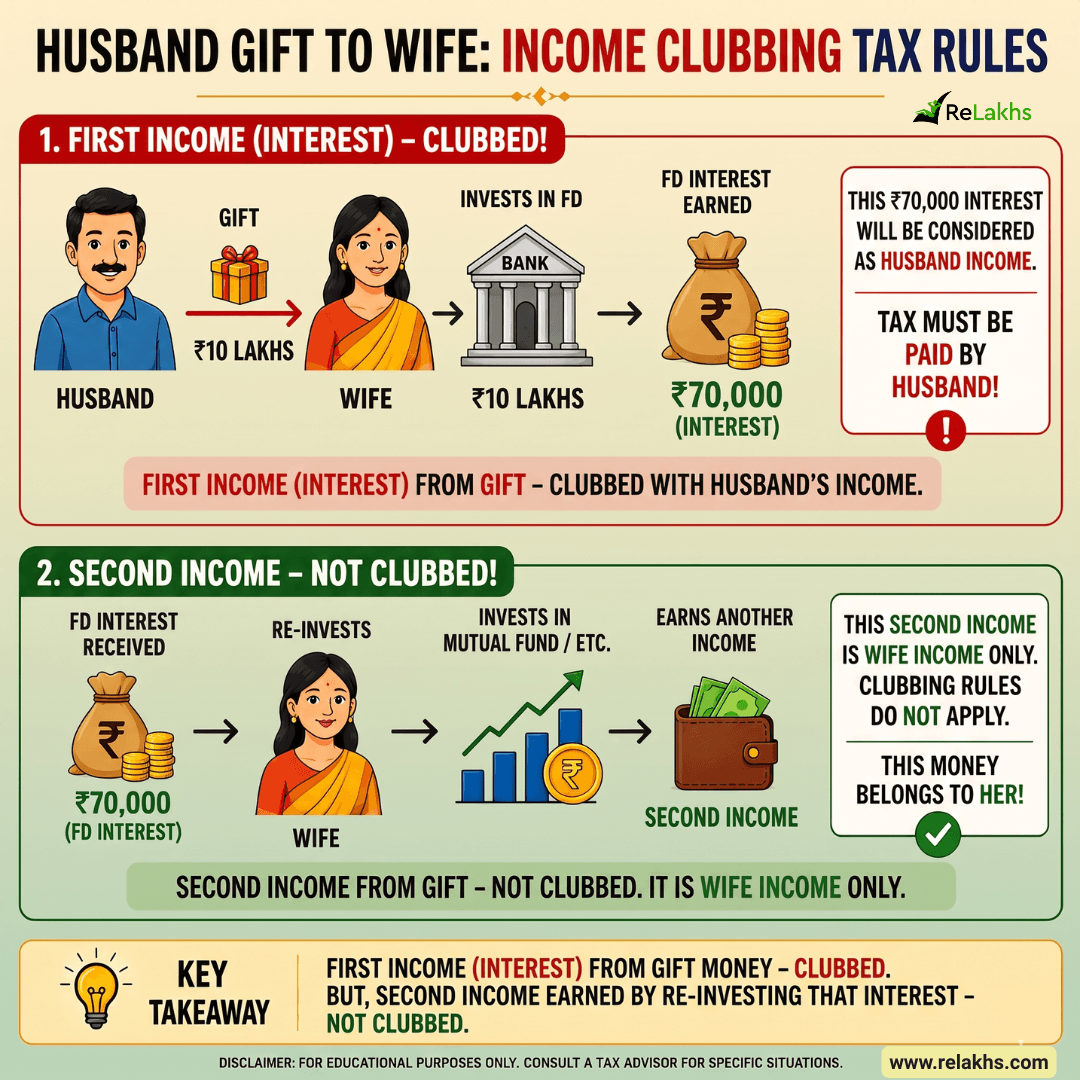
This is exactly where clubbing provisions can quietly come into play. If you gift money to your spouse and that amount gets invested in an FD, the interest earned on it may still be taxed in your hands, not your spouse’s, depending on the applicable provisions of the Income-tax Act.
So gifting money to your spouse doesn’t automatically shift the tax liability onto them. The income can still get “clubbed” back with your own income for tax purposes, which is something a lot of people overlook when they try to reroute investments within the family.
Scenario 8 – My Minor Child Has an FD. Is the Interest Taxable in My Child’s Hands?
Generally, the interest earned on an FD in the name of a minor child is clubbed with the income of the parent whose total income is higher, subject to the provisions of the Income-tax Act. However, clubbing generally does not apply if the minor earns income through their own skill, talent, specialized knowledge or manual work. Certain exceptions also apply in specified disability-related cases.
Scenario 9 – I Am a Senior Citizen. Do I Get Any Tax Benefit?
Yes, senior citizens do get some relief here. Resident senior citizens can claim a deduction under Section 80TTB if they’re following the Old Tax Regime, subject to the prescribed limit and conditions. (Section 80TTB is now renumbered as Section 153.)
This deduction isn’t limited to just FDs—it covers eligible interest earned from:
- Savings accounts
- Fixed deposits
- Recurring deposits
- Certain other bank deposits
One important thing to keep in mind, though: this benefit is available only under the Old Tax Regime. If you’ve opted for the New Tax Regime, you won’t be able to claim this deduction, so it’s worth factoring that into your decision when choosing between the two regimes.
Scenario 10 – Is Interest on a Tax Saver FD Tax-Free?
No, and this is another misconception people often fall for. Investing in a Tax Saver FD can get you a deduction on the amount you invest, under the applicable provisions (if you’re eligible and depending on the tax regime you’ve chosen).
But that deduction is only for the investment itself—it doesn’t make the interest you earn on that FD tax-free. The interest continues to be fully taxable, just like a regular FD, so you still need to report and pay tax on it each year.
Scenario 11 – Is Company FD Taxed Differently from Bank FD?
The basic rule stays the same whether it’s a bank FD or a company FD. Interest earned from both is generally taxable as per your applicable income tax slab—there’s no special exemption just because the deposit is with a company instead of a bank.
That said, a few practical differences do exist. The issuer, the TDS provisions, and the overall risk profile can vary quite a bit between bank FDs and company FDs. So don’t assume that Company FD interest is tax-free simply because it isn’t issued by a bank—tax-wise, it’s treated just like any other interest income, even though the safety and TDS rules around it may differ.
Scenario 12 – Is Interest on an NRE Fixed Deposit Taxable?
Interest earned on an NRE Fixed Deposit is generally exempt from tax in India, provided the applicable conditions under the Income-tax Act and FEMA are satisfied. If your residential status changes, the tax treatment may also change.
Scenario 13 – Is Interest on an NRO Fixed Deposit Taxable?
Yes. Interest earned on an NRO Fixed Deposit is generally taxable in India. Banks may also deduct TDS as per the applicable provisions. If required, report this income while filing your Income Tax Return.
Scenario 14 – I Took a Loan Against My FD. Does It Affect Tax?
No. Taking a loan against your Fixed Deposit does not change the taxability of the interest earned. You continue to pay tax on the FD interest according to the applicable provisions.
Scenario 15 – My Interest Was Automatically Reinvested. I Didn’t Receive Any Money. Is It Still Taxable?
Yes. Taxability does not always depend on whether the money reaches your savings account. If the interest has accrued or been credited in accordance with the applicable tax rules, it may still be taxable.
Scenario 16 – My FD Is in the Name of an HUF. Who Pays Tax?
If the Fixed Deposit belongs to a Hindu Undivided Family (HUF), the interest income is generally taxable in the hands of the HUF and not in the hands of its individual members. Proper ownership and accounting records should be maintained.
Scenario 17 – The FD Holder Passed Away. Who Pays Tax on the Interest?
This is a situation many families face.
Interest earned up to the date of death is generally taxable in the hands of the deceased (through the legal representative while filing the final return, if applicable). Interest earned after the date of death is generally taxable in the hands of the legal heir(s) or the person(s) who become entitled to the income, depending on the facts. The nominee is not automatically the beneficial owner merely because they receive the proceeds.
Scenario 18 – What About TDS on FD Interest?
Many taxpayers confuse TDS with income tax. Remember these three simple rules:
- TDS is not your final tax.
- No TDS does not mean no tax.
- TDS deducted can be claimed as tax credit while filing your ITR.
Always reconcile your interest income with your AIS, Form 26AS and the bank’s interest certificate.
| Category | TDS Rule (FY 2026-27) |
|---|---|
| Regular Citizens | No TDS if interest up to ₹50,000 per bank. |
| Senior Citizens | No TDS if interest up to ₹1,00,000 per bank. |
| Without PAN | TDS @ 20% instead of 10%. |
Starting this financial year (FY 2026-27), the traditional Form 15G and Form 15H for avoiding TDS have been replaced by a unified self-declaration form called Form 121.
Scenario 19 – Can FD Interest Create Advance Tax Liability?
Yes. If your overall tax liability (after considering eligible TDS and tax credits) exceeds the prescribed limit (₹10,000 or more), you may also have to pay advance tax. However, resident senior citizens not having income from business or profession are generally exempt from paying advance tax.
Scenario 20 – How Should I Report FD Interest in My Income Tax Return?
While filing your ITR:
- Calculate the total FD interest earned from all banks and financial institutions.
- Report it under Income from Other Sources.
- Claim deduction under Section 80TTB, if eligible.
- Claim credit for TDS deducted.
- Verify the figures with AIS and Form 26AS before filing your return.
Never report only the TDS. Report the actual interest income first.
Final Thoughts
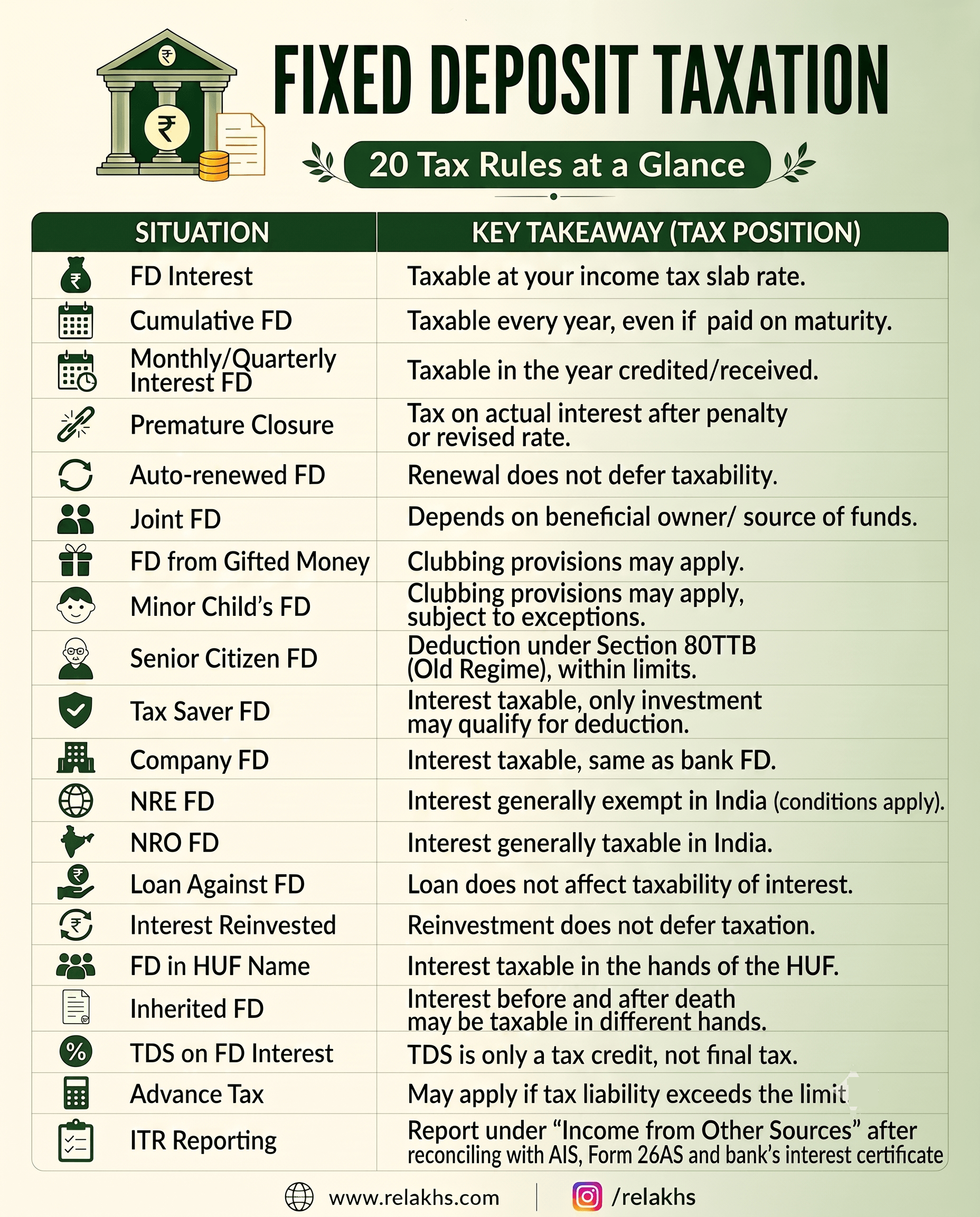
Fixed Deposits may be one of the simplest investment products, but their tax treatment is often misunderstood. Misreporting FD interest—or assuming that TDS settles your tax liability—can lead to avoidable notices or tax demands.
Understanding these common scenarios can help you file your Income Tax Return correctly and stay compliant with the law. If you have multiple Fixed Deposits across different banks, make it a habit to reconcile your interest income with your AIS, Form 26AS (Form 168) and bank statements before filing your return. A little attention today can save you a lot of trouble tomorrow.
Continue reading:
- India’s 35-Year Journey of 1-Year Bank FD Interest Rates (1990–2026)
- Income Tax Deductions FY 2026-27: Complete Guide to Old vs New Tax Regime
- New Income Tax Forms 2026: Full List & Form Numbers Explained
- Who gets the Joint Bank Account Monies if one Account Holder dies?
(Post first published on: 27-July-2026)
Join our channels