
Every year, around this time, my inbox fills up with one familiar complaint:
“Why do I have to submit Form 15G / 15H to every single company I’ve invested in?”
Dividends from five mutual funds? Five forms.
Interest from three bonds? Three more forms.
Senior citizens with long portfolios? A full‑time paperwork job.
Union Budget 2026 finally acknowledges this very real, very Indian problem — and fixes it.
Form 15G / 15H Before Budget 2026: The Real Pain Point
Until now, avoiding TDS was unnecessarily messy:
- You had to submit separate Form 15G / 15H to each company, AMC, or registrar.
- Miss one? TDS gets deducted.
- Late submission? Too bad — wait for refund after filing Income Tax Return (ITR).
- Senior citizens often depended on intermediaries just to stay compliant.
This wasn’t tax compliance. This was friction. This has been a real pain.
Budget 2026 Update: Form 15G & 15H Filing via NSDL and CDSL
Budget 2026 introduces a centralised mechanism using depositories — NSDL and CDSL.
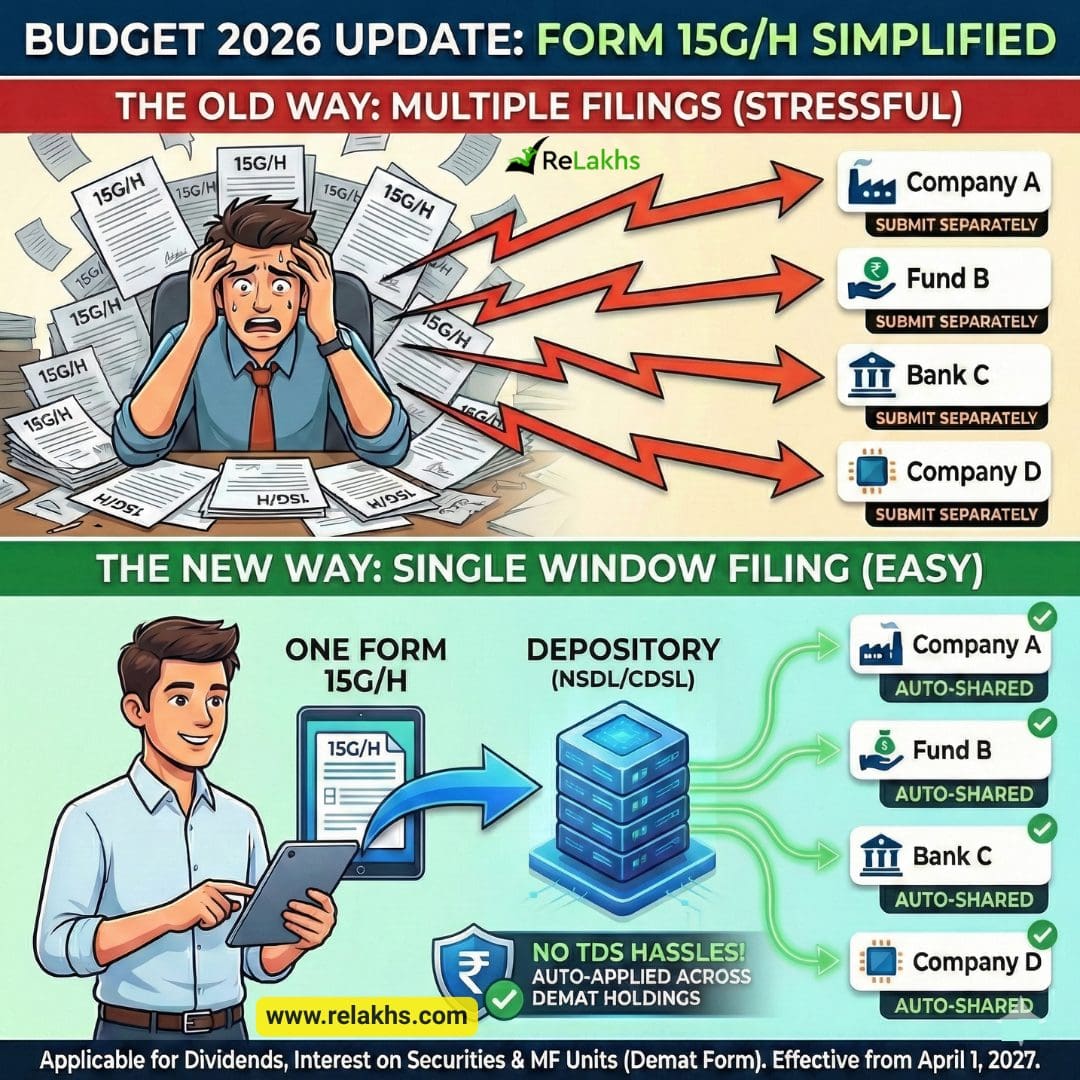
How it works;
- Submit once: File a single Form 15G or 15H with your Depository (NSDL or CDSL).
- Auto‑sharing: The depository electronically shares it with all relevant companies, banks and mutual fund houses.
- No repetition: No more uploading the same form again and again.
What Income Is Covered Under the New Form 15G / 15H System?
This facility applies only to securities held in Demat form:
- Dividends from shares
- Interest from listed bonds / NCDs
- Income from mutual fund units
As long as the holding is in your Demat account, the system works seamlessly.
Regular bank savings accounts, as well as traditional fixed deposits (FDs) and recurring deposits (RDs), are still maintained within the bank’s core banking system rather than in a Demat account. Because of this, the new single-window Form 15G/15H filing via NSDL/CDSL does not automatically cover these deposits. So, for now, you will still need to submit your Form 15G or 15H directly to the bank, either through NetBanking or the bank’s mobile app.
Eligibility: Who Can Submit Form 15G and Form 15H?
- Form 15G → Resident individuals (below 60 years)
- Form 15H → Senior citizens (60+)
No change in eligibility rules.
Effective Date: When Will the New Form 15G / 15H System Start?
This new procedure is effective from April 1, 2027.
How Banks and Issuers Receive Your Form 15G / 15H Data
Let’s say you hold a bond issued by Bank X, but it’s in your Demat account.
Here’s what happens:
- You submit Form 15G/H once to NSDL / CDSL
- Depository identifies Bank X as the issuer
- Declaration is electronically sent to Bank X
- Bank X updates its tax records
- No TDS deducted on interest payout
Conclusion: Why the Form 15G / 15H Change in Budget 2026 Truly Matters
i believe, this is one of the most practical reforms in Budget 2026.
- Less paperwork
- Fewer mistakes
- Faster compliance
- Lower dependency on intermediaries
If you invest regularly in bonds, mutual funds, or dividend‑paying stocks, this is one Budget change worth remembering.
Continue Reading:
(Post first published on : 01-Feb-2026)
Join our channels