
A bank account can be operated by a single account holder (or) multiple account holders. You can choose the joint account option while opening an account or whenever you require.
We may think that this is a simple option which is available on Account opening application form. Actually it is a very useful and an important option.
You need to be sure as to why you want to open a joint account? Who can be your joint account holder(s)? Trust and relationship equation weigh a lot while choosing the joint-account options.
Latest Article : Who gets the Joint Bank Account Monies if one Account Holder dies?
Types of Joint Accounts in India:

You need to be aware of different types of joint accounts offered by banks, based on the mode of operation and accessibility.
Either (Or) Survivor – This is the most common form of joint account. Only two individuals can operate the account i.e., primary account holder and secondary account holder. Both can access the account and transfer the funds.
The final balance and interest (if any) will be paid to the survivor on death of anyone of the account holders. The survivor can opt to continue the account.
If the nominee is a different person then the balance money is paid to him/her after the death of the survivor.
Example : Mother and daughter can open a joint-account. On death of anyone of them, the surviving person can continue the account or get the account balance transferred to her name.
Anyone (Or) Survivor – This is similar to “either or survivor” option. The only difference is, more than two individuals can operate the account.
If you want your father, mother and spouse to be able to access and operate your bank account then this is the best option. In case of death of anyone of the account holders, the remaining survivors can continue to operate the account.
Former (Or) Survivor – In this type of joint account, only the first account holder (primary) can access and operate the account till the time he/she is alive. The second account holder (second applicant) can operate the account only on death of the primary holder (first applicant). The survivor can also get the balance transferred to his/her name (if required).
Latter (Or) Survivor – This is similar to “former/survivor” option. The main difference is, only the second account holder can access and operate the account till the time he/she is alive. The primary/first account holder can operate the account only on death of the secondary account holder.
Example : Husband and wife are the joint-account holders. Wife is a second account holder . Then in this case, only wife can operate the account. Only after she is no more, can the husband have access to operate the account.
Jointly – In this type of account, all the transactions need to be signed and mandated by all the account holders. If any of the account holder dies then the account can not be further operated. The balance proceeds shall be payable to survivor.
Jointly or Survivor –This is similar to “jointly” option. The only difference being, the survivor can continue to operate the account. Alternatively, the proceeds of the account can be transferred to his/her name.
Along with the above options there is another type which is “Minor Account.” If the primary account holder is less than 18 years of age then there should be an adult guardian, as a joint account holder.

(Below image is the screen-print of various ‘modes of operation’ provided on State Bank of India’s Account opening form.)
Addition or Deletion of name(s) of Joint account holder(s)
You can request the bank to add a new joint account holder or delete any of the existing joint account holder’s names. But, all the existing account holders have to sign on the request form if the mode of operation is “either or survivor” or “jointly“. Do remember this point.
Let’s say two brothers (A & B ) opened a joint account with “Either or Survivor” option. B (Second account holder) started misusing the account funds. A decides to delete the name of B from joint account. But, the banker says that they require B’s consent for the deletion.
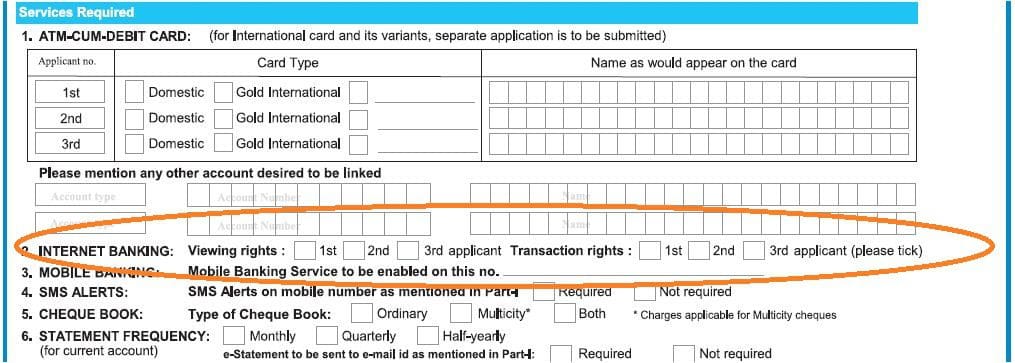
Primary/First applicant can restrict internet banking access for other joint account holders (if required). Some banks provide this option in Account opening form itself. Below image ( SBI account opening form) gives you an idea about this. By choosing these options, one can provide limited access to other joint account holders.
Another important point you should be aware of is the tax treatment of joint accounts. There are chances that your banker may treat the interest income on joint-account as income of Primary account holder only (unless the primary holder mandates the bank about the specific percentages).
The various types of joint accounts provide lot of advantages like ease of operating the account, convenience, rights of survivorship etc., But do spare a thought before you add anyone as a joint-account holder.
Latest Article : Who gets the Joint Bank Account Monies if one Account Holder dies?
(Image courtesy of Mister GC at FreeDigitalPhotos.net)
Join our channels





How can i close joint account without signature/cooperation of the other account holder who is the primary account holder ?
In a joint account with latter or survivor mode of operation whose customer ID will be used to carry out transactions and operations w.r.t. joint account. Debit or card will be issued by bank in whose name in latter or survivor mode of operation, and who will be responsible for tax liability in latter or survivor mode?
Dear Sadhna,
The second account holder can operate the account, so debit card will be issued under his/her name.
Banks generally make primary account holder liable for tax matters.
Related article : Who gets the Joint Bank Account Monies if one Account Holder dies?
Dear Sreekanth,
I have a small question – I have a joint account in SBI with my father and my father wants to un-link his registered mobile number and re-link my mobile number. Can my father do it without my consent.
Sir mera khata band ho gya hai.. Ar uspe anyone or survivor likha hai… To kya ek bande ke jane pe khata khul jayega kya
Hi sir,
Me and my Father are having a joint account in the bank. My father was deceased,and the bank is asking me to do the Dearth Claim and close the account..
It was an Either or survivor account…
Is it necessary to do dearth claim….
Please suggest…..
Dear Karteek,
I believe that you can keep using the account.
However, the surviving account holders should present a copy of the decedent’s death certificate to their bank as soon as possible. This allows the bank to retitle the account in the survivors’ names and avoids issues with accessing the account in the future.
Good evening sir, Sir i want to ask a question about the Former or Survivor, is it that the former (primary account holder) open the account before the second person came to join him? Or how? I’m confused please make it clear to me.
Hi,
It simply means that in a joint bank account the first named person (primary a/c holder) will operate the account in all circumstances except in case of his/her death. Only in case of death of the first person the joint holder (on former or survivor basis) would be eligible to operate the account.