
Gold prices have risen significantly over the years, and many Sovereign Gold Bond (SGB) investors—particularly those who subscribed to the earlier SGB issues at much lower gold prices—are now sitting on substantial capital gains.
For these original subscribers, the combination of gold-price appreciation + 2.5% annual interest + the special tax treatment on eligible maturity redemption has made SGBs particularly attractive.
But there is an important question now coming up for many investors:
“I have made a good profit on my SGB. What happens when I sell or redeem it? Will my entire profit be tax-free?”
The answer is: it depends on how you exit the SGB.
This is especially important from 1 April 2026, because the rules governing the special tax exemption on SGB maturity redemption have changed.
The tax treatment now depends on:
- How you acquired the SGB
- Whether you were the original subscriber
- How long you have held it
- Whether you redeem it with RBI or sell it on the stock exchange
- Whether you hold it until maturity
- Whether you can claim an exemption under Section 86
So, if you are an SGB investor sitting on substantial gains, this article explains the three possible exit routes—and the tax implications of each.
Let’s clear up the SGB taxation confusion once and for all.
First, what is a Sovereign Gold Bond (SGB)?
A Sovereign Gold Bond (SGB) is a government security issued by the RBI on behalf of the Government of India. Instead of buying physical gold, you invest in a bond linked to the price of gold. SGBs generally have an 8-year maturity and pay 2.5% annual interest on the initial investment, usually paid half-yearly.
For example, if you invested ₹5 lakh in an SGB: Annual interest = ₹5,00,000 × 2.5% = ₹12,500
With gold prices having risen significantly, many investors—especially those who subscribed to earlier SGB issues—are sitting on substantial gains. So the key question is:
How much of that profit is actually taxable? – That depends on how you exit your SGB.
The Big SGB Tax Change From 1 April 2026
Under the amended Section 70(1)(x) of the Income-tax Act (as updated in 2025), the special capital gains exemption on SGB redemption is now available only if:
- You subscribed to the SGB at the original issue as an individual, and
- You held it continuously till maturity
The Finance Act, 2026 made this change effective from 1 April 2026. The Income Tax Department has also clarified that:
- The exemption does not apply to SGBs bought from the secondary market
- The exemption does not apply to premature redemptions
- This new rule is in force from 1 April 2026
Because of this, SGB exits now fall into three different situations, each with its own tax treatment.
The 3 Ways You Can Exit an SGB
Broadly, there are three ways to exit an SGB:
- Hold till maturity and redeem with RBI
- Tenure: 8 years
- You redeem directly with RBI at the end of the term.
- Premature redemption with RBI
- Allowed after 5 years
- Only on specific interest payment dates as per RBI rules.
- Sell on the stock exchange
- You sell your SGB units in the secondary market, like any other listed security.
The tax treatment is not the same for all three routes. Each exit path can lead to a very different tax outcome. Let’s break them down one by one.
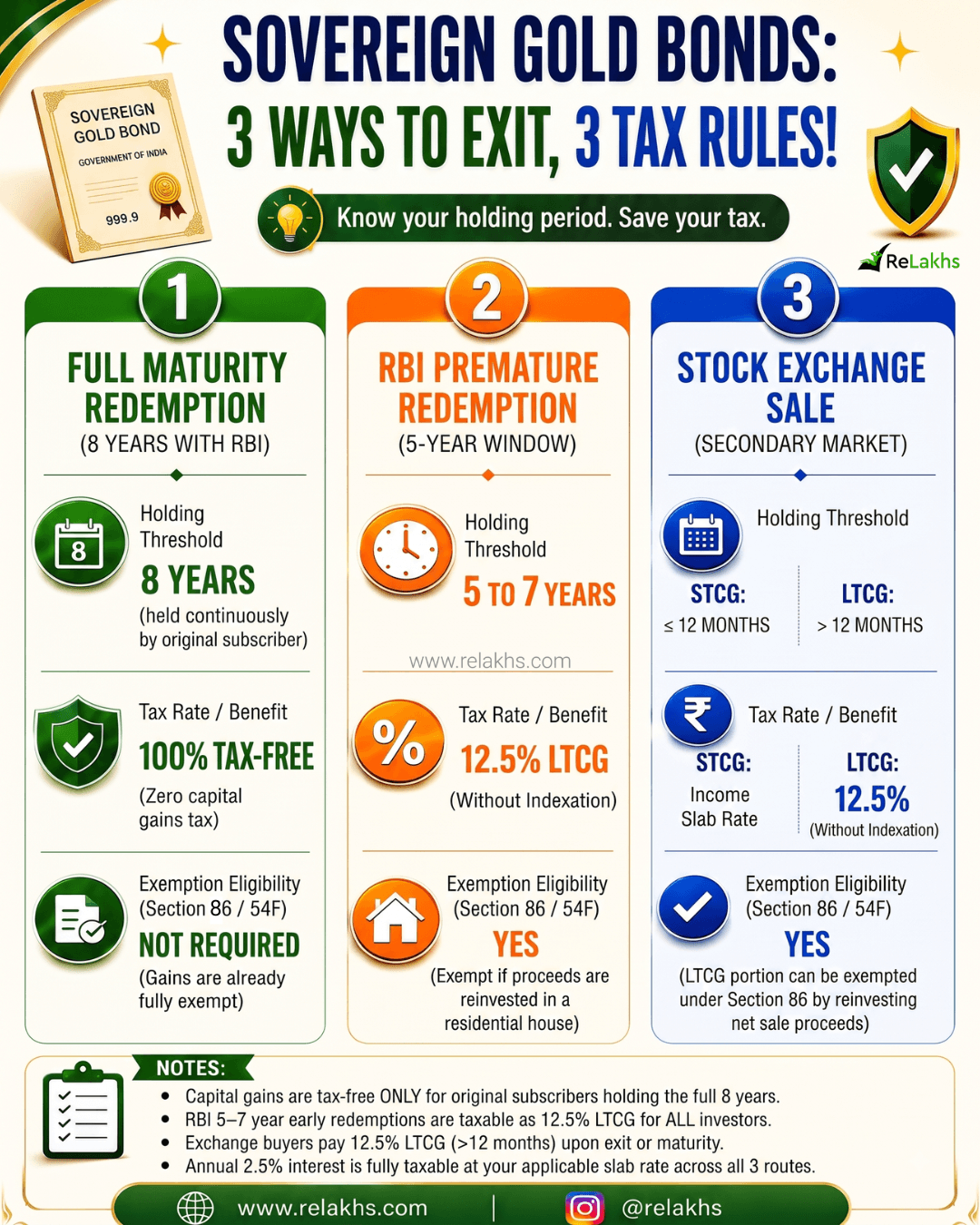
1. SGB Full Maturity Redemption: The Tax-Free Route
The SGB maturity gain is tax-free only when both conditions are met:
- You subscribed to the SGB at the original issue.
- You continuously hold it until maturity.
Example – You invested ₹5 lakh in an SGB at the original issue and hold it until the 8-year maturity. If the maturity value is ₹9 lakh:
Capital gain = ₹4 lakh → Capital gains tax = NIL
This exemption is available under Section 70(1)(x) of the Income-tax Act, 2025.
| Scenario | Maturity Capital Gain Exemption? |
|---|---|
| Bought at original issue + continuously held until maturity | Yes |
| Bought from stock exchange + held until maturity | No |
| Bought at original issue + sold before maturity | No |
| Bought from stock exchange + sold before maturity | No |
Remember: 8-year holding alone doesn’t make the gain tax-free. Original subscription + continuous holding until maturity = tax-free capital gain.
2. Premature Redemption With RBI
An SGB has an 8-year maturity, but RBI allows premature redemption after 5 years (5 to 8 Years), on specified interest-payment dates. This is not tax-free from 1 April 2026 because the Section 70(1)(x) exemption requires holding the SGB until maturity. The resulting gain is generally LTCG taxed at 12.5% without indexation.
Issue date → Year 5 → Year 6 → Year 7 → Year 8 maturity
Example:
- Investment: ₹5 lakh
- RBI redemption after 5 years: ₹8 lakh
- Capital gain: ₹3 lakh
- Tax @ 12.5%: ₹37,500 (Before applicable surcharge and cess.)
RBI premature redemption after 5 years is not the same as tax-free maturity redemption.
3. Selling SGBs on the Stock Exchange
You can also sell your SGB through a recognised stock exchange. This is a secondary-market sale, not RBI redemption. Here, your holding period determines the tax treatment:
| Holding Period | Tax Treatment |
|---|---|
| ≤ 12 months | STCG – slab rate |
| > 12 months | LTCG – 12.5% without indexation |
Example:
- Buy SGB for ₹6 lakh and sell for ₹8 lakh.
- Capital gain = ₹2 lakh
- Sold within 12 months: STCG → taxed at applicable slab rate
- Sold after 12 months: LTCG → ₹25,000 tax @ 12.5% (Before applicable surcharge and cess.)
Exchange sale = tax depends on your holding period.
How to reduce LTCG Tax on SGB?
Section 86 of the Income-tax Act, 2025 (corresponding to old Section 54F) can potentially provide exemption for taxable LTCG arising from an SGB exit, subject to its conditions.
- Maturity redemption: If you qualify for the Section 70(1)(x) SGB exemption, the gain is already exempt. Section 86 is therefore not required.
- RBI premature redemption: The resulting taxable LTCG may potentially qualify under Section 86.
- Stock-exchange sale: Taxable LTCG may potentially qualify under Section 86. STCG does not.
Key Section 86 Conditions
Broadly, the taxpayer must:
- Be an individual or HUF and have LTCG from an eligible long-term capital asset.
- Invest the net consideration in a qualifying residential house in India.
- Purchase the house within 1 year before or 2 years after the transfer, or construct it within 3 years.
- On the date of transfer, you should not own more than one residential house other than the new house.
- The exemption depends on how much of the net sale consideration you invest in the new house. Simply reinvesting the capital gain does not automatically make the entire LTCG tax-free.
Section 70(1)(x) → Special SGB maturity exemption
Section 86 → Residential-house reinvestment exemption
SGB Taxation After 1 April 2026: The Easy Cheat Sheet
There are three main ways to exit an SGB, and the tax treatment can vary significantly depending on the exit route, holding period and how the SGB was acquired. The 2.5% annual interest is taxable separately in all cases.
| Exit Route | Key Condition | Capital Gains Tax |
|---|---|---|
| RBI Maturity Redemption | Original subscriber + continuous holding until maturity | Exempt |
| RBI Premature Redemption | After 5 years, before maturity | Generally 12.5% LTCG |
| Stock Exchange Sale | Held ≤ 12 months | STCG – slab rate |
| Stock Exchange Sale | Held > 12 months | 12.5% LTCG, without indexation |
| Annual SGB Interest | All routes | Taxable at applicable slab rate |
SGB Taxation Examples
| Scenario | Investment / Purchase | Exit Value | Gain | Holding Period | Tax Treatment |
|---|---|---|---|---|---|
| 1. Original subscriber → Maturity | ₹5 lakh | ₹9 lakh | ₹4 lakh | 8 years | NIL – Exempt under Section 70(1)(x) |
| 2. Original subscriber → RBI premature redemption | ₹5 lakh | ₹8 lakh | ₹3 lakh | 5+ years | LTCG @ 12.5% = ₹37,500 |
| 3. Buy from exchange → Sell | ₹6 lakh | ₹7 lakh | ₹1 lakh | 8 months | STCG – Applicable slab rate |
| 4. Buy from exchange → Sell | ₹6 lakh | ₹8 lakh | ₹2 lakh | >12 months | LTCG @ 12.5% = ₹25,000 |
Taxes shown are before applicable surcharge and health & education cess. No indexation benefit is available for the 12.5% LTCG regime.
Simple takeaway: The same SGB can have very different tax outcomes depending on how you acquired it, how you exit, and how long you held it. For taxable LTCG, you may also be able to claim an exemption by reinvesting in a residential house, subject to the prescribed conditions under Section 86.
Final Thoughts
If you already own SGBs, don’t make an exit decision based on tax alone. Before exiting, check your:
- Original issue and subscription details
- Holding period and maturity date
- Current value and RBI redemption eligibility
- Tax impact of each exit route
Sometimes, paying tax on an early exit may still make financial sense if a better opportunity exists.
Continue reading:
- Gold Investments Tax Treatment in India | Taxation rules on Gains from Selling Physical Gold, Gold MF, Gold ETFs
- Income Tax Deductions FY 2026-27: Complete Guide to Old vs New Tax Regime
(Post first published on : 17-Aug2026)
Join our channels