
In India, more than 1/3 of the money that is in circulation is in the form of Rs 500 & Rs 1,000 currency notes. The incidence of fake currency circulation and usage of high denomination notes for illegal activities has been increasing for the last many years.
In a move to curb the rising incidence of fake notes and black-money menace, the Indian government has declared that currency notes of Rs 1,000 & Rs 500 will not be legal tender from 9th November, 2016. Newly designed Rs 500 note and new notes for Rs 2,000 will be brought into circulation.
The public can exchange the notes in the next 50 days (10th Nov to 30th Dec, 2016) in any Bank or Post office branch.
In this post, let’s understand – How to exchange the existing Rs 500 & Rs 1000 currency notes in Banks or Post office branches? What are the withdrawal limits that are imposed over the next few weeks? What would be the impact of banning high denomination currency notes?
High Denomination Notes Banned – What is the impact over the next few weeks?
- 9th November – The existing Rs 500 & Rs 1,000 currency notes won’t be usable from 9th November, 2016.
- 9th November – Banks & ATM machines will not be available for public.
- 10th November – Banks will be open for public works. ATMs in some places might not function.
- 11th November – All ATMs will be available for the public.
- 10th Nov to 30th Dec – Banks & post office will accept money exchanges.
- Till 30th Dec – RBI waives charges on ATM transactions for all banks till December 30th, 2016.
- 31st Dec, 2016 to 31st March, 2017 – People who possess Rs.500 or Rs. 1000 currency notes after December 30 can exchange them at Reserve Bank of India centres only.
Exemptions list for next 72 hours (till midnight of 24th Nov, 2016)
You can use the old Rs 500 & Rs 1000 currency notes at the below places;
- Govt Hospitals & Pharmacies.
- Ticket booking counters of Railways, Govt buses and Airlines ticket counters at Airports will accept the Rs 500& Rs 1,000 currency notes.
- The notes are also accepted at Petrol, diesel & gas stations, milk booths authorized by State Governments.
- You can use old high denomination notes to pay Toll-Gate fees, LPG refill bookings, Electricity & Water bills, Court Fees & Govt taxes.
How to exchange old Rs 500 & Rs 1000 Currency notes? What are the limits on Withdrawals?
You can exchange your Old High Denomination Notes (OHD) for value at any of the 19 offices of the Reserve Bank of India or at any of the bank branches or at any Head Post Office or Sub-Post Office. You can exchange the notes over the next 50 days i.e., from 10th Nov to 30th Dec, 2016. Below are some of the FAQs on money exchange scheme;

- Is there any limit on Cash Swap? – You can exchange your high denomination notes up to Rs 4000 per person in cash. Beyond this limit, the amount has to be deposited in bank account.
- Where can I exchange old Rs 500 & Rs 1000 notes? –
- For exchange upto Rs 4,000 in cash (revised to Rs 2,000) you may go to any bank branch. You have to provide a valid ID proof.
- If you want to exchange over Rs 4,000 then you have to visit the bank branch (home branch) where you have an account. You can also exchange the notes at any other branch of the same bank.
- In case you are exchanging in a bank branch of any other bank where you are not maintaining an account, you will have to furnish valid identity proof and your bank account details. The respective bank will do electronic fund transfer to your bank account.
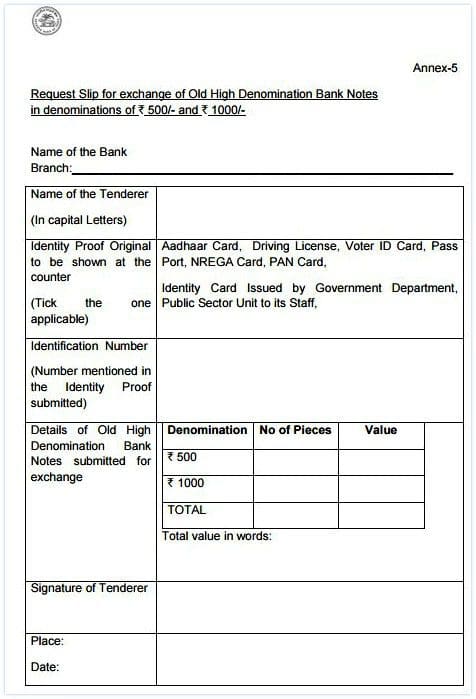
- What is accepted as Valid ID Proof at the bank? – You can provide any of these ID proofs : Aadhaar Card, Driving License, Voter ID Card, Pass Port, NREGA Card, PAN Card, Identity Card Issued by Government Department, Public Sector Unit to its Staff.
- Can I deposit old high denomination notes through ATMs? – Yes, the old notes can be deposited in Cash Deposits machines / Cash Recyclers.
- I do not have bank account, can I use my Friend’s or Relative’s bank account? – Yes, this is acceptable. Your relative or friend (account holder) has to give you permission in writing. While exchanging the notes at the bank where your friend has an account, you should provide to the bank – the evidence of permission given by the account holder and your valid identity proof.
- How much amount can I withdraw from ATM? – The ATMs are going to be functional from 11th November, 2016. you can withdraw from ATMs upto a maximum of Rs.2,000/- per card per day (revised to Rs 2,500) upto 18th November, 2016. The limit will be raised to Rs.4000/- per day per card from 19th November 2016 onwards.
- How much cash can I withdraw at the Bank? – Cash withdrawals from bank accounts (or) over the bank counters, will be restricted to a limited amount of Rs 10,000 per day subject to an overall limit of Rs 20,000 a week (revised to Rs 25,000 & daily limit of Rs 10k has been removed) from November 9, 2016 till end of business on November 24, 2016. The limits will be reviewed after this.
- Can I make online money transfers through my Bank account without any limit? – Yes, the money available in your bank accounts can be freely used by issue of cheques or by remitting through various electronic modes of transfer like NEFT, RTGS, IMPS, mobile banking, internet banking etc.
- I am currently in a foreign country, how can I exchange the notes? –
- If you have high denomination bank notes in India, you can authorize your representative in India in writing. He/she can deposit your notes into your bank account.
- Your representative has to submit the authorization letter & his/her valid ID proof to your bank account along with the bank notes.
Below is the ‘Cash Exchange’ request slip that has to be submitted along withe old Bank notes. Kindly click on the image to open it in a new browser window.
Latest Update :
- Cash deposits of Rs 2.5 Lakh and above made during the 50 day window period (10th Nov to 30th Dec, 2016), could attract income tax plus a 200% penalty in case of income mismatch. Govt has requested all banks & Post offices to furnish the reports of all cash deposited during this period, above a threshold of Rs 2.5 Lakh in every account. This is limit is Rs 12.5 Lakh in case of a Current Account.
- Cash withdrawals of up to Rs 2.5 Lakh can be made fro marriage purpose from the KYC compliant bank account.
My Opinion :
- This bold decision by the Govt will certainly have its impact on all our lives. In short-term, if you have to deal with or make any cash payments then you are going to face some hardships over the next few weeks.
- As mentioned above, more than 1/3rd of bank notes which are in circulation are high denomination bank notes only. So, it might take some time for the RBI to print and make the new notes available to the public. If less money is available, this can impact the purchasing power in the short-term, this can lead to low levels of Inflation.
- The sectors like Real estate (especially the un-organized segment) , Bullion market, Consumer goods, automobiles, infrastructure etc., will have negative impact in short-term. The property prices might come down but I believe that once the dust settles down, the construction activities can pick-up when the middle class families start buying properties (if they are available at affordable prices).
- We all know that lot of cash is used for Health-care treatments, Higher Education expenses, buying Properties, luxury products, Gold ornaments, exchange of Agricultural produce etc., The non-availability of high denomination notes can have huge impact on these transactions.
- Lot of cash (white or black money) gets invested in Chit funds, especially in towns and rural areas. So, these companies may now have to do business in a ethical and legal way (or) have to close their businesses altogether.
- We all know that all the major political parties are very full funded and are cash rich. So, Govt should impose restrictions on the cash payments to the Political parties 🙂
- I believe that less number of cash transactions will take place in the long-run and this is good for the entire economy. More Indian families will come into the hold of banking system.
- Wasteful expenditures & corruption can come down.
- We need to do our bit by educating the less privileged member of the society like your house-maids, sabjiwala, driver etc., about the money-exchange scheme. If possible, accept their Rs 500 & Rs 1000 bank notes and re-pay them in low denomination bank notes for time-being.
This bold decision might actually create a havoc in the short-term. The un-organized players across different industries will feel the heat and will help them get organized. More number of organized players results in more tax revenue for the Govt.
Whether this move will eradicate the entire Black-money present in our economy. May be or may not be. But, the existing hoards of black or un-accounted money has been made useless overnight, which is good for the economy!
Whether this move will stop creating black-money over the next few years? – Govt is going to launch new high denomination notes again, so cash (legitimate or illegitimate) may pile up again. So, this kind of demonetization has to be done periodically.
These kind of reforms related to Currency / taxes should be done on a continuous basis. Let’s hope we are moving towards the ‘Cashless Economy’ in the longer run and this is a step in the right direction!
Kindly share your views and comments.
Continue reading : RBI introduces new 500 & 2000 Rupee Bank Notes with advanced features – How to identify new 2000 & new 500 Rupee Bank Notes?
(Post published on 08-November-2016) (Image courtesy of Teeratas at FreeDigitalPhotos.net)
Join our channels


I have old notes of rs 4000 what should I have to do now
Dear ashwin ..You have to visit nearest RBI office and try exchanging the old high denomination notes.
Hi ,
I have old currency with 5000. How can i exchange after dec 30 2016? i am a normal citizen.
Dear srikanth . You can get them exchanged at RBI centres only.
Sreekanth,
My Mother having savings of worth 3 lakhs which she earned for past 10 years by lending money for interest nearby place in my hometown. But she is not paying tax and also not having PAN card.
I have opened bank account for my Mother but bank accepting only 49000 since she is not having PAN.
What can I do…
Dear Marimuthu..You may kindly get her a PAN.
Hai, Are mutual funds safe after demonetising in india? I have invested is MF’s as below :
1. Franklin India Prima Plus Growth – 3lacs
2. HDFC Mid cap Opp Fund – 3 lacs
3. ICICI Prudential Focused Blue – 3 lacs
Please advise if i should make any change or remain invested.
Investments is done vide monthly SIP and has started 1 year ago.
Thanks ,
Anu
Dear Anupama,
May I know what do you mean by SAFER?
All the three funds are good ones. What is your investment objective & time-frame?
Sreekanth,
I am doing retail and distribution business in hardware and paints. Shall i accept OHD currencies from my dealers’/customers for their outstanding balance as on 8-Nov-2016, if yes can i deposit that amount into my firm’s OD account?
Also provide what is the deposit limit for OD/ CC account holders till 31-Dec-2016
Dear BALAJI,
Suggest you not to accept the OHD as your business does not fall under the ‘exemption list’.
You may request them to do online transfers instead.
Thanks sreekanth, what is the limit for deposit OHD currency in OD/CURRENT ACCOUNT?
Dear BALAJI ..There is no limit as such for depositing the amount in Bank accounts.