
Silver has touched a lifetime high of above ₹4,00,000 on 28 January 2026, and precious metals have become the hottest topic in the investor community. Many Indian investors who already own gold and silver are feeling happy — and a bit validated.
At the same time, some people feel they should have invested more, while others think they missed the chance completely. When prices reach new highs, people often feel excited, regretful, and confused all at once — which is exactly why we need to stop and think about what we’re actually investing in.
So the next questions that come to mind are: should I invest more in precious metals, is now a good time to buy silver, and where does copper fit into all of this?
Should We Invest in Precious Metals Now?
Before deciding whether to invest in precious metals now, there’s one thing you must understand — silver is not gold.
This is the most common mistake investors make. When prices are high and everyone is talking about precious metals, many treat silver as just a cheaper version of gold. In reality, silver behaves very differently and carries its own risks and rewards.
To answer whether you should invest in precious metals now — and whether silver or even copper fits your plan — we first need to see how gold, silver, and copper each play a different role in your portfolio.
Gold vs Silver vs Copper
Gold is seen as a precious metal, Whenever gold prices move, silver usually grabs attention. But silver is different. It’s not just a precious metal — it’s also an industrial metal. while copper—though not considered a precious metal today—is used purely for industrial purposes.
Gold = Precious Metal
Silver = Precious + Industrial metal
Copper = Industrial Metal
What’s pushing Silver prices up?

There are three main reasons why many people are optimistic about silver right now;
- First, the rise of green energy is boosting demand. Solar power relies heavily on silver, and as global solar installations keep increasing, so does the need for this metal.
- Almost 50–60% of silver demand comes from industries like:
• Solar panels
• Electric vehicles
• Electronics
• Medical equipment
- Almost 50–60% of silver demand comes from industries like:
- Second, concerns about inflation, geo-political risks (wars) and weakening currencies are pushing investors toward tangible assets. When money loses value over time, people tend to turn to metals like silver as a form of protection.
- Third, supply is struggling to keep up. Silver production has not grown as quickly as demand, creating tighter markets and adding to the bullish sentiment.
- For example, the market recorded a deficit of about 149 million ounces in 2024, and even though supply is expected to grow modestly, the gap is projected to remain in the 100–120 million ounce range in 2025 and likely persist into 2026, according to industry outlooks from the Silver Institute and other commodity analysts
So silver or copper prices don’t move only on fear, inflation, or uncertainty — they also move with economic growth (industrial activity).
Gold = Protection (mostly a Safe-heaven)
Silver = Protection + Growth
Copper = Growth
How Volatile are Silver vs Gold Prices?
Silver and copper prices are not driven only by fear or inflation; they are also closely linked to economic growth. As a result, their price movements—both upward and downward—are significantly more volatile than those of gold.
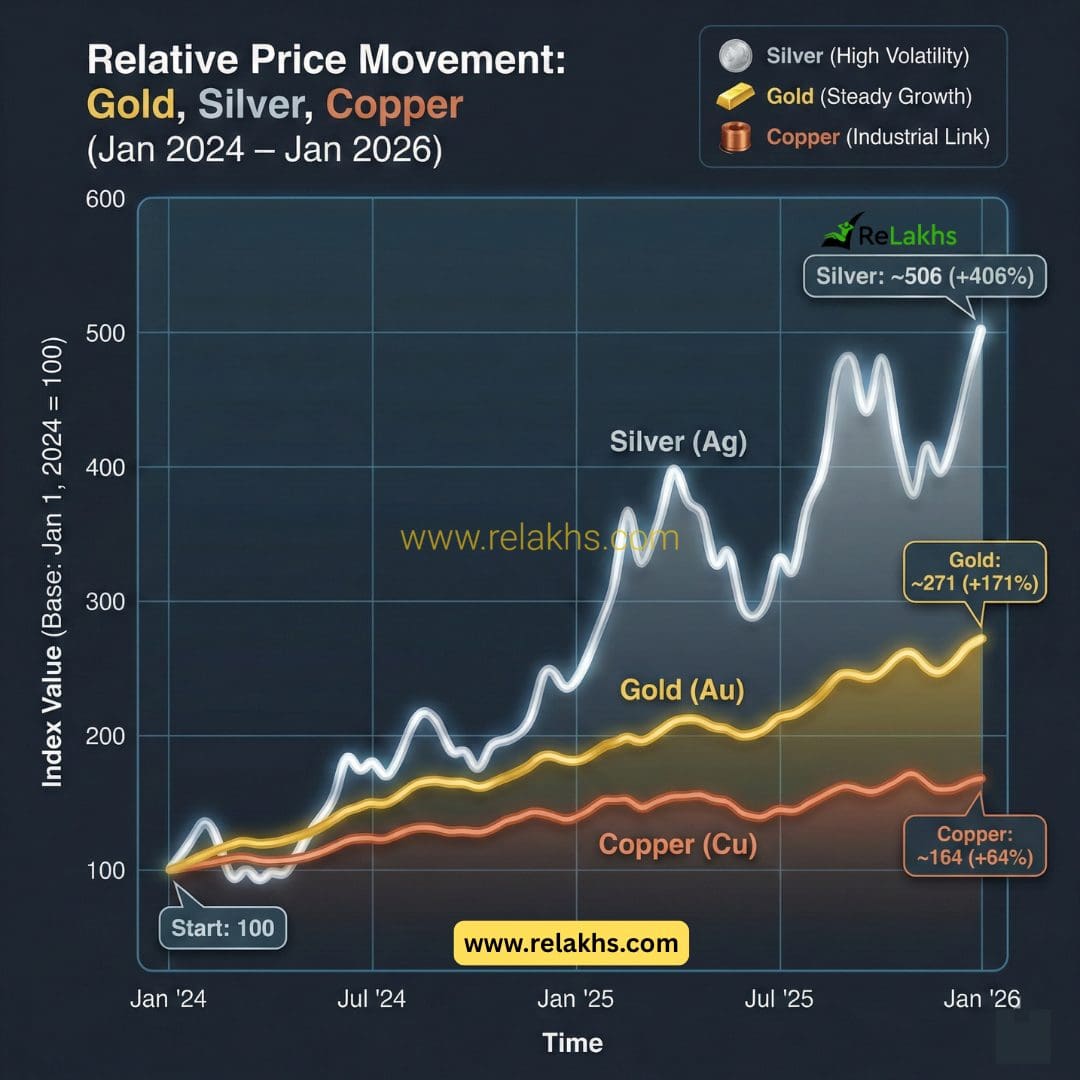
Now look at how each of them behaves. Gold tends to be relatively stable, with low volatility, and acts as a steady hedge over time. Silver is more volatile, typically falling in the medium‑to‑high range, while copper is the most volatile of the three, closely tied to the pace of economic growth.
Historically, gold’s annual volatility has hovered around 14–15%, whereas silver’s has been roughly 27–29%. That’s why silver tends to swing almost twice as much as gold—and copper moves even more sharply, closely tracking the ups and downs of an economy. (Annual volatility means how much an asset’s price moves up and down in a year.)
Gold — low volatility (compared to silver/copper), stable hedge
Silver — medium to high volatility
Copper — high volatility, growth-driven
This volatility shows up clearly during market stress or low industrial growth as well;
In earlier market cycles, silver has often fallen 30–40% quite quickly. Over the long term, silver’s biggest drop has been around 54%, while gold’s worst fall has been about 25%. During the March 2020 (covid) crash, gold fell roughly 15%, silver dropped close to 30%, and copper also fell sharply as people suddenly became worried about economic growth.
When economic growth slows:
- Gold tends to protect value (may hold value and may even rise during recessions).
- Silver finds it harder to hold up (may fall initially and then recover later).
- Copper usually falls the most (When growth expectations collapse, copper tends to decline early and deeply.)
So should you invest in silver now?
So the real question is not whether silver is good or bad. The more useful question is how much silver fits into your portfolio. How much silver is right for me?
If your financial basics are already in place—such as an emergency fund, health and life insurance, and a balanced mix of equity and debt investments—then silver can work as a diversifier, sitting somewhere between gold and growth‑oriented assets. However, it should not become the main or “hero” part of your portfolio, but rather a supporting piece that adds variety without taking center stage.
For most long‑term investors, keeping about 5–10% of the portfolio in silver is more than enough. If you go beyond that, your portfolio starts to rely too much on short‑term price moves instead of steady wealth building. At that point, it starts to feel more like speculation than real investing. Avoid investing in precious metals, or any commodity, purely out of fear of missing out if they don’t fit your risk appetite and long-term financial goals.
Final Verdict: 2026 still looks like a “buy on dips” year for metals. Gold acts as the anchor, while silver and copper are the ones that offer the potential for higher returns (alpha). Invest in small portions and always respect their high volatility.
Which metal do you prefer for the next market cycle—gold, silver, or copper? Let me know your view in the comments.
If tracking gold, silver, copper, equity, and debt separately feels overwhelming, multi-asset mutual funds can be a sensible middle path. You may not catch every rally, but you also reduce the risk of chasing what’s already hot.
Continue reading:
Disclaimer: For educational use only; not financial advice. Past performance is not indicative of future results. Commodity prices are volatile and may vary locally due to taxes and duties. All multi‑asset funds are structured differently, so always review how your money is actually divided across asset classes before investing. Consult a SEBI-registered advisor before investing.
Source: LBMA, COMEX, and LME spot price data (Jan 2024 – Jan 2026).
(Post first published on : 29-Jan-2026)
Join our channels



Confused as to what to invest in
Hi..That’s normal. Clarity comes from asset allocation, not from picking products. Kindly focus on goals, time horizon, and risk tolerance first.