
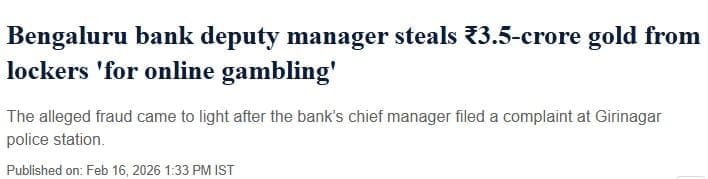
In a shocking breach of trust, an assistant manager at Indian Bank’s Girinagar branch in Bengaluru was arrested for allegedly stealing gold worth ₹3.5–₹4.12 crore from customer lockers and pledged gold packets (gold loan).
What happens when the person trusted to protect your gold is the one stealing it? That is exactly what played out at a public sector bank branch in Bengaluru, and it is a textbook case of how blind trust and weak controls can cost customers crores.
The incident has once again raised a serious question:
Are valuables really safe in bank lockers? And what are your rights under RBI rules? Let’s break this down.
What Happened in the Bengaluru Gold Locker Fraud Case?
The accused was Kiran Kumar E (34), an Assistant Manager at the branch. Not an outsider. Not a robber breaking in at night. An insider. And that makes all the difference.
What was stolen?
- Around 2.78 kg of gold ornaments
- Gold that customers had pledged against loans
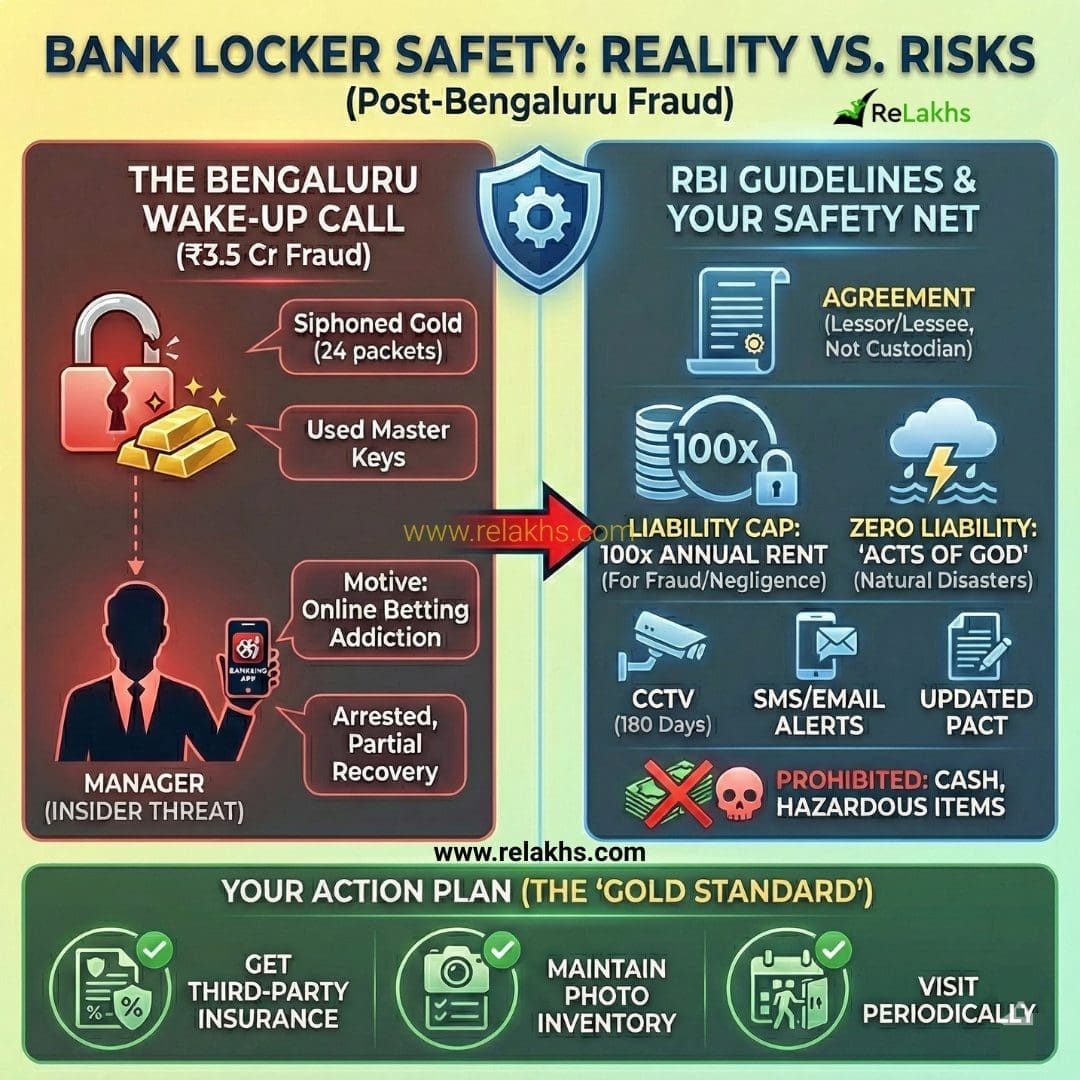
- 24 sealed packets were tampered with
- Estimated value: ₹3.5–₹4.12 crore
How was it done?
Between June 2025 and January 2026, he allegedly misused his access to the master keys and quietly siphoned off small quantities of gold from different packets over time. The shortage in each packet was too minor to raise immediate suspicion or be noticed in a single customer visit. It was these tiny cuts, spread across multiple packets and stretched over several months, that made the fraud so dangerous.
Motive:
Police investigations revealed addiction to online betting and gambling. The stolen gold was reportedly pledged with private finance companies.
How did it finally come out?
A woman closing her gold loan found ornaments missing. A stock verification audit revealed gold fully missing from 3 packets and partially missing from 21 others. Which means the siphoning had been happening quietly for months.
Why the Fraud Went Undetected for 8 Months?
In this case:
- Gold packets were sealed
- Borrowers did not inspect periodically
- No personal photo inventory maintained
The fraud was caught only when a borrower physically noticed missing jewellery.
What happens now?
A case has been registered under Section 316 of the Bharatiya Nyaya Sanhita for criminal breach of trust. As of late February 2026, police have recovered between 700 grams and 1.2 kg so far. The police are currently moving the court to compel non-cooperative finance companies to return the remaining gold.
So, Are Bank Lockers 100% Safe? What RBI Rules Say?
Short answer: Safer than home. Not bulletproof. Under RBI regulations, your relationship with the bank is that of a lessor and lessee, not full custodian.
This means: The bank does not insure the full value of your locker contents.
Here are the latest RBI guidelines and the reality of locker safety as of 2026:
RBI Guidelines on Bank Locker Liability (2026)
- The “100 Times Annual Rent” Rule: If locker contents are lost due to bank negligence, employee fraud, fire, or building collapse, the bank’s liability is capped at 100 times the annual locker rent. So if the rent is ₹3,000, maximum compensation is ₹3,00,000, even if you kept gold worth ₹50 lakh. This is one of the most misunderstood locker rules in India.
- No Liability for Natural Disasters: Banks are generally not liable if locker contents are lost due to floods, earthquakes, lightning, or other “Acts of God”. Even if your documents are destroyed, you usually cannot claim compensation in such cases.
- Mandatory Security Measures: Banks must now ensure CCTV coverage in locker areas (with footage preserved for 180 days), send SMS/email alerts for locker access, and issue revised locker agreements. If you have not signed the updated agreement, check with your branch.
- Items You Cannot Keep: You are not allowed to store cash, hazardous materials, or illegal items in a locker. If cash or suspicious contents are found during a legal break-open, it can lead to complications, including tax and legal scrutiny.
What About Pledged Gold? Your Rights as a Borrower
In the Bengaluru case, much of the stolen gold was allegedly re‑pledged for fresh loans, which makes it even more important for you (borrowers) to know your rights.
- At Loan Sanction: Appraisal must happen in your presence. Get document with gross/net weight, purity, assay details. Keep this document safely.
- During Loan Tenure: You can submit a written request to the Branch Manager. Banks usually allow an inspection under supervised conditions, though they may charge a nominal “re-valuation” or “inspection” fee.
- At Loan Closure: Don’t sign loan closure document (discharge) in hurry. Insist on re-weighing in your presence. Match original sheet. Note discrepancies. If there is deterioration or shortage, the lender is legally liable. Gold must be returned within 7 working days post-repayment.
- If the bank delays returning your gold beyond 7 working days after full repayment, they must pay you a penalty of ₹5,000 per day of delay
How to Truly Protect Yourself?
Since bank liability is capped at just 100x annual bank locker rent, here’s what you should do to protect yourself:
- Photo Inventory (Your Best Evidence): At every locker visit:
- Take entry photo (with timestamp)
- Photo of items removed/added
- Final photo before locking
- Store in cloud with date labels + keep visit slips & SMS alerts. This becomes critical evidence in disputes.
- Buy Separate Insurance (Banks Won’t):
- Option A: Locker Insurance – IFFCO-Tokio offers specific cover
- Option B: Home Insurance + Jewellery Rider (HDFC ERGO, ICICI Lombard, Tata AIG, Bajaj Allianz)
- Covers: Locker + home safe + transit
- Check: Per-item limits & “mysterious disappearance” exclusions
- Verify Regularly: Even pledged gold can be inspected on request. Don’t assume “sealed packet = safe.” Request inspection during loan tenure. Don’t trust blindly.
Final Thought:
The Bengaluru gold fraud isn’t just about one dishonest employee—it’s a wake-up call for all of us.
It is a reminder that:
- Banks are institutions.
- Systems have limits.
- Liability is capped.
- Proof burden is often on you.
A locker gives physical security. Insurance gives financial security. Documentation gives legal security. You need all three.
Continue reading:
- SBI ₹60 Lakh Personal Accident Policy for ₹3,000 Per Year- Worth it?
- Indian Household Savings Pattern 2025 | Where did Indians invest?
- List of 20 Key Central Government Schemes for Personal Finance | 2026
(Post first published on :22-Feb-2026)
Join our channels