
Many people avoid writing a Will because they think it is only for older people, or because talking about death and inheritance feels uncomfortable. But avoiding it does not prevent problems — it usually creates more confusion, family disputes, and legal hassles later for nominees and legal heirs.
Whether you are building wealth or simply want to protect your family’s peace of mind, it helps to clear these myths early. Here are 10 common myths about Wills in India — and the real legal facts you should know.
10 Common Myths vs. Truths About Wills
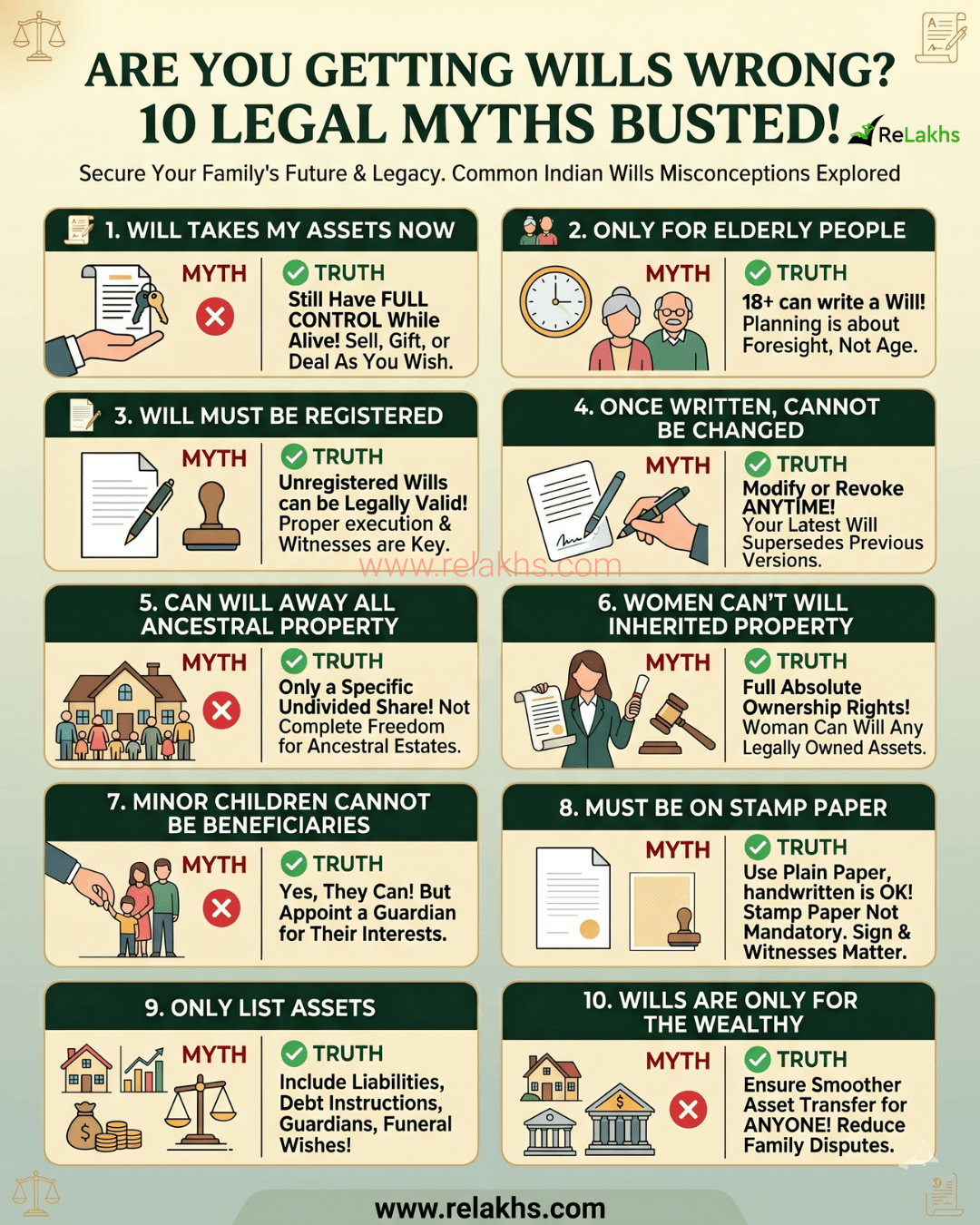
Myth 1: If I Write a Will, I Lose Ownership of My Assets Immediately
The truth: Writing a Will does not change your ownership in any way. You still have full control over your assets during your lifetime, and you can sell, mortgage, gift, or use them however you want.
Reality check: A Will does not mean giving away your property today. It simply leaves a clear instruction for tomorrow. As long as you are alive, you remain in complete control of your wealth.
Myth 2: Only Senior Citizens Need a Will
The truth: In India, any adult above 18 who is of sound mind and owns assets can make a Will. Life is unpredictable, and accidents do not wait for the “right age.”
Myth 3: A Will Must Be Registered to Be Legally Valid
The truth: Under the Indian Registration Act, 1908, registering a Will is completely optional. A Will written on plain paper is still valid, as long as it is properly signed and attested by witnesses.
Why people get confused: Registration is not mandatory, but it is still a smart step. A registered Will is kept in safer custody, which makes it harder for family disputes or forgery claims to arise later.
Myth 4: Once Written, a Will Can Never Be Changed or Revoked
The truth: A Will is fully flexible. You can change it with a Codicil or even cancel and rewrite it completely any number of times during your lifetime, as long as you are mentally fit.
Important law: In court, the latest valid Will is the one that matters. It overrides all earlier versions and is treated as your final wish.
Myth 5: A Father Can Leave All Ancestral Property to Anyone He Chooses
The truth: This is one of the biggest sources of confusion in Indian family disputes. Under Hindu Succession law, you cannot fully Will away ancestral property. You can only Will your own undivided share. The rest belongs by default to the other coparceners (heirs by birth).
Note: If the property is self-acquired (bought with your own income), you have full freedom to give it to anyone you choose.
Myth 6: A Woman Cannot Dispose of Inherited Property via a Will
The truth: Section 14 of the Hindu Succession Act, 1956 clearly states that any property held by a Hindu woman, whether inherited, received as a gift, acquired through partition, or earned by her own effort, is her absolute property—not limited ownership. She has full legal right to Will it to anyone she chooses.
Myth 7: Minor Children Cannot Be Named as Beneficiaries
The truth: You can absolutely leave your assets to minor children (under 18). But since a minor cannot legally manage property, you must appoint a trusted Guardian in your Will. This Guardian will hold and manage the assets for the child until they turn 18.
Myth 8: A Will Can Only Be Written on Costly Stamp Paper
The truth: You do not need stamp paper for a Will at all. A Will written on plain white paper, even handwritten, is fully legal. What matters under Section 63 of the Indian Succession Act is proper execution: it must be signed by you in the presence of at least two independent witnesses, who also sign the document.
Myth 9: Only assets and balances need to be listed in a Will
The truth: A good estate plan covers much more than bank accounts. A well-written Will can and should also include:
- Outstanding loans and how they should be settled
- Guardianship details for minor children or dependents with special needs
- Personal wishes, funeral preferences, or charitable donations
Myth 10: Wills Are Only For Wealthy Families
Truth: Whether you own a house, a plot, bank deposits, investments, or even digital assets, a Will can help ensure a smooth transfer and reduce the possibility of family disputes.
Important: Nominee vs Will
Many investors believe that the nominee in a bank account, mutual fund, or FD automatically becomes the owner of the money. In most cases, a nominee is only a trustee or receiver of the asset. The ultimate ownership is generally decided by the Will or applicable succession laws.
Remember:
- Nomination helps in receiving the asset.
- A Will helps determine who finally inherits it.
Some exceptions may apply, such as certain company shares/debentures and Sovereign Gold Bonds (SGBs), where nominee rights can be treated differently under specific laws and regulations. A nomination is important, but it is not a substitute for a Will.
The Key Rule: A nomination is a temporary convenience for the bank; in most scenarios your Will determines the final, permanent owner of your wealth.
The Legal Checklist: What Makes a Will Valid?
To ensure your document holds up against legal scrutiny, verify that it ticks these fundamental structural boxes:
| Requirement | What It Means | Status |
| Capacity | The person making the Will (Testator) must be 18+ and of sound mind. | Mandatory |
| Free Will | The document must be created without coercion, fraud, or undue influence. | Mandatory |
| Attestation | Signed by the Testator in the presence of at least two witnesses. | Mandatory |
| Stamp Paper | Executing the text on government stamp paper. | Optional |
| Registration | Filing the document at the local Sub-Registrar’s office. | Optional |
Final Thoughts
Too many people see a Will as a bleak, end-of-life document. In reality, it is a living tool of responsibility. It gives clear direction, protects your family’s emotional and financial interests, and helps preserve harmony among your loved ones when they are most vulnerable.
A Will does not take away your assets today. It simply ensures your hard work is respected tomorrow, and that your family is not left facing an expensive, stressful legal maze.
At the end of the day, family property disputes rarely happen because assets are large. They happen because of unwritten assumptions.
Continue reading:
- Nominee Vs Legal Heir : Who will inherit (or) own your Assets? | Importance of WILL
- How to write a WILL & Sample WILL
- Property Gift Deed – All you wanted to know!
Important Note: Inheritance and succession laws are not identical across all religions in India. Some concepts discussed here, particularly ancestral property and birth rights, are primarily relevant under Hindu succession laws.
(Post first published on : 04-June-2026)
Join our channels